Revenue Operations in MedTech – Why the Function That Connects Sales, Service, and Data Will Define the Next Decade
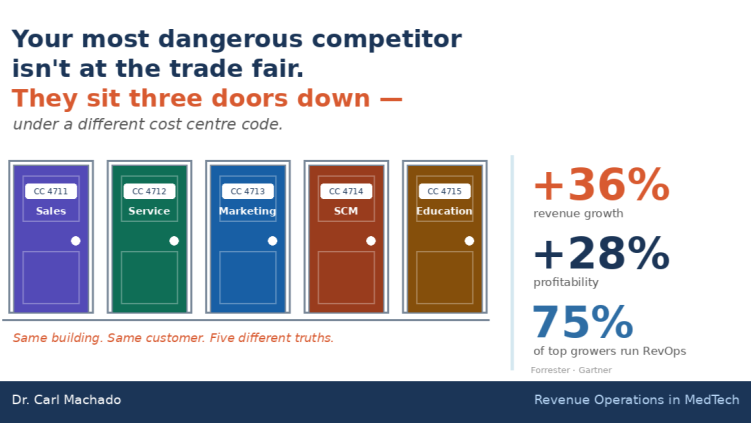

Most MedTech companies still run sales, service, and education as separate silos — each with its own metrics, its own leadership, and its own definition of „customer success.“ Revenue Operations changes that. After 18 years building and leading commercial organisations at Philips, J&J, and corpuls, here is what I have learned about what actually works.
The Silo Paradox: Strong Functions, Weak System
A hospital is evaluating whether to renew a major service contract. The sales team is convinced the relationship is solid — they closed the original deal, they attend the annual review, procurement knows them by name. The service team, meanwhile, has been quietly managing three open complaints for four months. And the clinical education team has no idea the device was updated six weeks ago with a workflow change that requires retraining. Nobody is lying. Nobody is incompetent. They simply are not connected — and the renewal is already at risk before anyone has noticed.
I have observed this pattern across every large organisation across he industry over almost two decades. The architecture is remarkably consistent: several isolated departments, each genuinely trying to develop the business within its own remit; objectives that are partially contradictory by design; processes that are rarely completed end to end because they cross a departmental boundary somewhere in the middle; and no unified toolchain — each function operating its own systems, its own data definitions, its own version of the truth. The intentions are always good. The structure makes conflict inevitable.
Jacco van der Kooij rightfully stated:
„Organizations need to ensure that specialization is paired with a well-defined, cross-functional process and job training for each role. Without a well-defined process, customers and win rates will suffer from poor handoffs between functions.“
A ZS Associates analysis of MedTech commercial organisations describes the resulting fragmentation precisely: procedure data in a case management system, contract data in a revenue management platform, interaction history in a CRM customised differently by each business unit, and external intelligence in spreadsheets that connect to nothing. This is not a technology problem. It is an organisational architecture problem — and it requires a structural answer, not another platform.
What Revenue Operations Actually Means — and What It Does Not
Revenue Operations, or RevOps, has generated considerable hype in B2B commercial circles. Before applying the concept to MedTech, it deserves a precise definition — separated from the consulting pitch.
RevOps is the structural alignment of all revenue-generating, customer-facing functions — marketing, sales, service, and clinical education — under a shared strategy, a shared data infrastructure, and shared accountability for revenue outcomes across the full customer lifecycle. It is not a rebranding of sales operations. It is not a dashboard layer on top of fragmented systems. And it is not primarily a technology initiative.
The organising principle is the customer journey itself. It begins with lead generation in marketing operations, runs through the optimisation and measurability of the sales process, and continues — critically — into an integrated post-sales organisation whose mandate is to keep satisfaction high, prevent churn, and systematically optimise the renewal of existing contracts. The commercial model of a MedTech company is not a funnel that ends at the point of sale. It is a cycle. Every break in that cycle is a revenue and, consequently, a profit loss — usually an invisible one, because no function owns the break.
The evidence for the model is substantial, even if it originates largely outside MedTech. Gartner has projected that 75% of the highest-growth companies globally will adopt a RevOps model. Forrester research shows that companies aligning people, processes, and technology across their revenue teams achieve 36% more revenue growth and up to 28% higher profitability than siloed organisations. Deloitte’s 2024 B2B sales research found that organisations with mature RevOps functions were 1.4 times more likely to exceed revenue goals by 10% or more. The MedTech context is more complex — clinical stakes, regulatory constraints, multi-stakeholder procurement — but the structural logic transfers intact: when the functions that generate and protect revenue operate in isolation, commercial performance is capped regardless of how strong any individual team may be.
KEY CONCEPT: „Revenue Operations is not a technology project, a rebranding of Sales Ops, or a restructuring exercise for its own sake. It is a deliberate operating model designed to connect what today is disconnected — and to make the customer experience match the organisation that customers assume exists, but that rarely does.“
The MedTech Revenue Journey Is Not Linear
In a conventional B2B product company, the revenue funnel is relatively legible: marketing generates demand, sales converts it, post-sales and customer success retain it. The handoffs are sequential. In MedTech, the revenue journey is neither linear nor sequential. It is cyclical, multi-party, and deeply entangled with clinical use.

Consider the lifecycle of a capital equipment account – let me share a composite scenario, drawn from industry patterns, not from any specific account or employer: The initial sale may take eighteen to thirty-six months and involve procurement, clinical, finance, MedTech, and IT stakeholders at the hospital. Upon installation, a service contract is negotiated — often separately, by a different team, sometimes against a different price book. Over the contract term, the clinical education team provides procedure training, device updates require retraining, and consumable revenue is generated case by case. At the contract renewal point, two to five years later, the hospital’s clinical champion may have changed, the procurement contact may be new, and the competitive landscape will have shifted.

McKinsey’s analysis of the MedTech aftermarket shows that service-focused companies can generate up to 35% of their revenue from services, with that revenue stream delivering superior margin stability compared to capital equipment cycles. The same research finds that customers with paid service agreements demonstrate higher brand loyalty and higher repurchase rates for consumables. The commercial logic is clear. But capturing that value requires connecting the teams that manage the relationship across its lifecycle — which most MedTech organisations are structurally not designed to do.

The Four Pillars of a MedTech RevOps Organisation
Generic RevOps frameworks describe three pillars: marketing operations, sales operations, and customer success operations. In MedTech, the model must be extended to four — and enriched with interfaces that do not exist in other industries.
Marketing Operations
The entry point of the commercial cycle: lead generation, campaign attribution, marketing automation, and the qualified handoff of prospects to the sales organisation. In many MedTech companies this function is underdeveloped, because the sales representative was historically the primary demand-generation instrument. As hospital procurement consolidates and buying committees grow, the marketing function’s role in shaping and pre-qualifying pipelines becomes structurally more important.
Sales Operations
The engine room: CRM governance, territory and quota management, pipeline stewardship, forecasting accuracy, incentive design, and commercial reporting. In most MedTech organisations this is the only RevOps-like capability that exists in formalised form — but it operates in isolation, without a structured connection to service or customer satisfaction outcomes. It also requires a close, structured, and well-governed link to supply chain functions: forecast accuracy and delivery reliability are two sides of the same commercial promise.
Service Operations
Where the majority of customer lifetime value in MedTech is won or lost — and the most consistently undervalued element of commercial governance. Contract management, renewal tracking, service-level monitoring, complaint workflows, and the systematic identification of upsell and cross-sell triggers from installed-base data are not back-office administrative tasks. They are commercial functions. The renewal conversation for a critical device in a cardiac catheterisation laboratory begins not at contract expiry but in the quality of every service interaction over the preceding years.
Clinical & Commercial Education Operations
The fourth pillar is specific to MedTech and absent from generic frameworks. Clinical and commercial education and training are not standalone learning programmes — they are a direct revenue driver. Procedure adoption rates, operator certification levels, and retraining completion after software or workflow updates are all leading indicators of account health. An account with poor clinical adoption is not merely an education problem: it is a renewal risk, a competitive vulnerability, and — in the worst case — a patient safety concern.
One further interface completes the picture: because MedTech operates in a regulated environment, Revenue Operations requires a structured connection to regulatory and compliance functions. Contract structures, pricing governance, commercial disclosure, and post-market commitments all carry regulatory dimensions that other industries do not know. RevOps without compliance integration is, in this sector, structurally incomplete.
Three Structural Failures That Leave Revenue on the Table
Three different patterns can be identified — not failures of effort or intent, but of structure.
The Metrics Misalignment
Sales measures revenue booked. Service measures uptime and response times. Clinical education measures training completions. All legitimate — and none of them captures account health as a whole. A hospital account can show excellent service scores and above-target procedure volume and still lose the equipment renewal to a competitor, because no one tracks the integrated relationship.
Misaligned metrics drive misaligned behaviour. Sales teams, based on their incentive schemes, tend to prioritise new logo acquisition over renewal protection. Service teams optimise response times over upsell signals. Education teams measure attendance over adoption. Each team does what its incentives reward. The system underperforms in aggregate.
The Data Archipelago
Simon-Kucher’s analysis of commercial maturity in MedTech and diagnostics identifies a consistent pattern: tools bought as standalone fixes, customer and contract data scattered across systems, teams that do not trust the numbers, dashboards that describe what happened rather than guide what to do next — and no single owner of the end-to-end revenue process.

The practical consequences:
- A service engineer escalating a critical failure cannot see that the account is mid-renewal.
- A sales representative preparing that renewal cannot see the open complaints or the overdue certifications.
- An education manager planning training cannot see which accounts have the lowest adoption rates and therefore the highest commercial risk.
The data exists. It is simply not connected. And data alone creates no value: it must be translated into clear visualisation, structured analysis, and forward-looking decision-making before it changes a single commercial outcome. Nick Mehta captures this perfectly:
„If you define customer success differently in sales, marketing, and post-sales, you haven’t defined it at all.“
The Renewal Black Hole
Contract management is where siloed structures become most expensive. Simon-Kucher’s research on contract management in MedTech documents a set of recurring pitfalls:
- the absence of a central contract repository,
- reactive rather than proactive renewal management,
- and contract data so scattered that companies often lack even basic information such as contract end dates and customer notification periods.
Best-in-class organisations target coverage of more than 95% of contracts within a centralised contract lifecycle management system, and research shows that up to 30% of time spent on contract management can be recovered through process simplification and automation. That is not marginal efficiency. It is a material reallocation of commercial bandwidth — from administrative fire-fighting to proactive account development.
RevOps Is Not Enough: The Supply Chain Interface
Revenue Operations, as conventionally conceived, spans the commercial organisation. But in MedTech, revenue outcomes are shaped just as directly by what happens in supply chain and logistics — an interface rarely discussed in the RevOps literature, and almost never governed systematically.
The argument is straightforward. From the customer’s perspective, the value proposition of a MedTech supplier is its ability to keep critical equipment operational and supply intact. A customer who waits months for a replacement component that constrains the operating capacity of, say, a cardiac catheterisation laboratory will not remain loyal — even if the supplier is technologically and commercially superior to every competitor. A relationship built over years is dismantled not by a sales failure but by an inventory failure.
This is no theoretical concern. The years since 2020 have delivered a sequence of disruptions that exposed the vulnerability of lean inventory models and globalised logistics:
- During the COVID-19 pandemic, the International Road Transport Union reported that up to 425,000 professional truck driver positions in Europe — roughly 10% of the total — remained unfilled in 2021, with the shortfall forecast to worsen. Border closures, quarantine regimes, and vaccination-linked entry requirements compounded the shortage, hitting Eastern European transport corridors that carry a disproportionate share of European freight particularly hard.
- The energy crisis and the Russia–Ukraine war from February 2022 disrupted transport infrastructure, raw material availability, and logistics routing across the European manufacturing base.
- Global raw material shortages reached MedTech in less obvious ways: adhesives consumed at scale by the construction sector for building insulation were, at times, unavailable in sufficient quantities for medical applications. A supply decision made in one industry became a supply chain risk in another.
- The Panama Canal drought of 2023–2024 forced the Canal Authority to cut daily transits from the normal 36–38 vessels to as few as 18 by February 2024 — with full capacity restored only in August 2024. The canal carries roughly 5% of global shipping; for companies with Asia-Pacific sourcing or distribution, the queuing delays had material consequences for delivery reliability.
- US tariff escalations and the broader fragmentation of global trade have since added a further layer of price uncertainty and availability risk for components, sub-assemblies, and finished goods.
The correct response is not simply higher inventory — although targeted strategic buffer stock for critical, non-substitutable components in high-urgency clinical settings is a legitimate governance position. Nor does accepting higher safety stock mean abandoning inventory optimisation: the discipline of holding the right stock efficiently remains. The point is different: inventory cost is a finance metric, but customer service level during a supply disruption is a Revenue Operations metric. When the two are governed in isolation — finance optimising for inventory reduction, commercial functions optimising for satisfaction — the tension resolves badly in every crisis, and the customer pays for it first.
RevOps therefore requires an active interface with supply chain management: shared visibility of demand signals from the installed base, early-warning protocols when inventory risk intersects with high-value renewal accounts, and agreed escalation paths that allow commercial judgement to override lean-inventory defaults where clinical continuity is at stake. Supply continuity must be recognised — and governed — as both a commercial and a patient safety priority.
A customer who experiences months of restricted access to a consumable essential for high-volume procedures will not remain loyal to the manufacturer — even where the product is technically superior. The relationship cost of a supply failure in a cardiac catheterisation laboratory exceeds any short-term inventory saving.
From Lagging Metrics to Leading Indicators: The Customer at the Centre
The most persistent measurement problem in MedTech commercial organisations is the primacy of lagging indicators. Revenue recognised, uptime achieved, trainings completed: these tell you what happened. They do not tell you what is about to happen — and by the time a lagging indicator signals a problem, the commercial damage is usually done.
A personal example illustrates the mechanism. My relationship with a premium automotive brand began impressively. The sales consultation was professional, the vehicle was excellent, and for the first days of ownership the experience matched the promise. Then the service journey began: missed commitments, concerns unresolved across repeated appointments, a post-sales experience that bore no relation to the pre-sales one. I eventually left the brand. Note what happened commercially: revenue was generated — but once, not recurringly. The transaction succeeded; the relationship failed. And the sales organisation that won me never saw the deterioration, because the service journey was invisible to it. Revenue Operations exists to prevent exactly this outcome — along the entire value and satisfaction chain.
The pattern is structurally identical in MedTech. The sales cycle is managed with rigour; the service experience is managed by a different team, against different metrics, with a different definition of success. The customer experiences both as one continuous relationship. The company manages them as two separate transactions.
Customer satisfaction measurement — NPS, CSAT, service quality scores, clinical outcome feedback — provides the leading-indicator layer that lagging metrics cannot. A declining NPS trend detected twelve months before renewal is a recoverable situation; the same signal detected at the renewal table is not. The design question is not whether to measure satisfaction, but how to route the signal to the right decision-maker in time to act. Which indicators are suitable in MedTech specifically? These indicators I consider most predictive, based on industry evidence and practice:
- Transactional NPS and CSAT after every service intervention and training event — trended at account level, not merely aggregated globally, and routed to the account owner with defined response protocols and escalation paths.
- Complaint ageing: for illustration, any complaint open beyond a defined threshold (for example fourteen days), automatically visible to the commercial account owner — not only to the service queue.
- Procedure adoption rate: clinical procedure volume relative to installed base, with automated alerts when an account’s trend deviates from its baseline — the single strongest early signal of both renewal risk and training need.
- First time-fix rate and mean time to repair for critical equipment — operational service metrics that correlate directly with satisfaction and renewal probability.
- Training currency: the share of active operators with up-to-date certification after software or workflow updates — a compliance signal and a commercial one simultaneously.
- Renewal pipeline coverage at T-minus-18-months: the proportion of expiring contract value already in structured renewal dialogue — the leading indicator for the renewal black hole itself.
The incentive dimension follows directly. Modern commercial incentive systems should move beyond pure revenue and margin targets — which reward the transaction — toward hybrid structures that combine financial performance with customer satisfaction scores, renewal rates, and adoption metrics. Renewal rates in particular should be owned jointly by sales, service, and education — never assigned to a single function that cannot independently control the outcome. This is not a softening of commercial rigour. It is a more complete definition of commercial performance: one that pays for the health of the relationship, not merely the most recent invoice.
What Building RevOps Actually Requires
Building Revenue Operations in a MedTech context is not a single initiative but an operating model shift across five dimensions. The sequence matters as much as the components.
- A shared definition of the customer lifecycle. Before technology, before process redesign: the leadership team must agree a single map of the customer journey — from first engagement through installation, service contract, clinical adoption, renewal, and expansion — co-owned by sales, service, and education leadership. Everything else builds on this.
- A unified data layer with a single account view. Every function that touches the customer operates from the same account record. This does not require a technology overhaul; it requires agreement on which data fields define account health, which system owns each data type, and how the data flows. The CRM is the housing, not the solution. The solution is data governance discipline.
- Shared leading indicators. The indicator set from the previous section — satisfaction trends, complaint ageing, adoption rates, renewal coverage — visible across functions, with defined owners and response protocols. The shift is from measuring what happened to sensing what is about to happen.
- Cross-functional accountability at account level. A shared account review rhythm that brings sales, service, and education leads together around the accounts that matter most. Not an information-sharing meeting — an accountability forum, where the question is not what happened, but what we are doing about it and who owns it.
- Governance at leadership level. RevOps fails without executive sponsorship willing to adjudicate when functional incentives conflict. The service team’s uptime bonus and the sales team’s renewal commission may pull against each other on pricing; supply chain’s inventory targets may pull against clinical continuity. These tensions are not resolved by the CRM. They are resolved by leadership with a shared view of account value and the authority to allocate resources accordingly.

The Data Dimension: From Instrument to Intelligence
One aspect of Revenue Operations is genuinely new: the role of connected device data. MedTech companies increasingly know, in near-real time, how their installed equipment is used — procedure frequency, operator patterns, error codes, consumable consumption, software version status.
Historically this data served quality and service purposes. The next decade’s differentiation will come from integrating it into the commercial layer. Declining procedure utilisation is not just a service signal — it is an education trigger and a renewal risk indicator. A device approaching end of warranty in a high-volume account is not just a scheduling item — it is a renewal and upgrade opportunity. PwC’s 2025 industry analysis frames the point sharply: companies that treat data as a product — discoverable, consumable, actively exchanged across commercial, service, and clinical functions — will set the new competitive standard, while in most organisations that data remains locked in silos built for a different era.
The Governance Dimension: What Boards Should Ask
Revenue Operations has direct governance implications — particularly as MedTech companies shift toward recurring revenue models, value-based contracting, and outcome guarantees. For supervisory boards and advisory bodies, the following questions are worth posing to management:
- Do we have a single definition of customer lifetime value shared across sales, service, and education leadership — or does each function define „customer success“ differently?
- What percentage of our revenue is genuinely recurring, and how do we protect that base? Is renewal managed proactively, or reactively as contracts approach expiry?
- Can we, today, name the twenty accounts most at risk of churning in the next twelve months — and does a cross-functional plan exist for each?
- Is our connected device data integrated into commercial processes, or siloed in engineering and quality systems?
- Do our incentive structures reward the full health of the account — including satisfaction and renewal performance — or only the most recent transaction?
- Is supply continuity for critical clinical customers governed as a commercial KPI, with a structured interface between commercial and supply chain leadership when disruption risk is elevated?
Risks, Limits, and Typical Pitfalls
Intellectual honesty requires acknowledging where RevOps initiatives fail — because most of them do, at least partially, and the failure modes are predictable.
The tool-first trap
The most common failure is starting with a platform decision. A new CRM, a new analytics layer, a new contract management system — procured before the operating model questions are answered. Technology implemented on top of unresolved organisational conflict does not resolve the conflict; it digitises it. Industry surveys consistently attribute the majority of digital transformation failures to adoption and alignment, not to the technology itself. The sequence must be: lifecycle definition, governance model, metric set — then tooling.
Reorganisation theatre
The second failure is treating RevOps as an organisational chart exercise: renaming sales operations, appointing a VP of Revenue Operations, and declaring victory. Titles without adjudication authority change nothing. If the new function cannot resolve a conflict between the service team’s uptime bonus and the sales team’s renewal pricing, it is a coordination role, not an operating model — and coordination roles without authority are where good managers go to be exhausted.
Goodhart’s law and the satisfaction metric
When a satisfaction measure becomes an incentive target, it invites optimisation of the measure rather than the experience — survey timing manipulation, selective sampling, score-begging at the point of service. The defence is methodological: measure transactionally and trend at account level, triangulate NPS against behavioural indicators such as adoption and complaint ageing, and weight incentives toward outcomes that are difficult to game, such as renewal rates and multi-year retention. A satisfaction metric should inform judgement, never replace it.
Over-centralisation
Finally, RevOps can fail by succeeding too completely: centralising decision rights so far that field organisations lose the autonomy that makes them effective. The objective is shared data, shared indicators, and shared accountability — not a central function approving every discount. The test of good RevOps governance is that decisions happen faster, closer to the customer, with better information. If decisions are slowing down, the model is wrong.
Five Executive Imperatives for the Next 24 Months
Based on my own experience and on the analytical evidence available, I would offer the following to executives leading commercial organisations in MedTech:
- Audit your account lifecycle for ownership gaps. Map every major account from initial sale to most recent renewal. Identify the points at which nobody owns the relationship. Those gaps are where revenue leaks.
- Establish a single account record as a non-negotiable minimum. Before investing in AI or advanced analytics, ensure that sales, service, and education operate from the same account record, with agreed definitions and governance. Everything else builds on this.
- Design at least one shared commercial metric across functions. An account health score combining complaint status, adoption rate, satisfaction trend, and contract proximity — visible to all functions — changes behaviour faster than any reorganisation.
- Build renewal management as a commercial capability, not an administrative task. The renewal conversation begins eighteen months before expiry, with cross-functional input. Contract management is a commercial asset, not a back-office burden.
- Govern supply continuity as a commercial KPI. Establish a structured interface between Revenue Operations and supply chain management that makes inventory risk visible to commercial leadership — and gives commercial leadership a voice in escalation decisions affecting critical accounts.
Closing Observation
Revenue Operations is not a new idea. The logic of connecting the functions that touch the customer is as old as key account management. What is new is the structural urgency: tighter hospital procurement, value-based contracting, geopolitical supply volatility, and competitors with better data infrastructure are all raising the cost of fragmentation.
The customer does not experience your organisational chart. They experience the totality of every interaction — the first sales conversation, the installation, the service journey, the training programme, the renewal negotiation, and the delivery reliability in between. In most MedTech companies, each of those is managed by a different team with different objectives. The customer holds a single account of all of them — and decides accordingly.
My automotive experience illustrates this at a human level. The initial relationship was strong; the product was excellent. The service journey — invisible to the sales organisation — eroded the relationship until leaving became the only rational outcome. The same dynamic plays out in every MedTech account where commercial functions operate in isolation. The product may be superior, the clinical outcomes demonstrably better. But if the service experience, the renewal process, or the supply chain reliability creates sustained frustration, the customer will leave…
Eighteen years in this industry have left me with one conviction: the gap between the best and the rest will increasingly be a Revenue Operations gap. It will not be closed with another platform. It will be closed by leadership willing to redesign the operating model around the customer, rather than around the organisational chart.
Sources
ZS Associates (2026): From Fragmented Capabilities to Customer-First MedTech CRM. zs.com
McKinsey & Company (2026): Capturing Value from Customer-Centric MedTech Services. mckinsey.com
Simon-Kucher & Partners (2026): End-to-End Revenue Management in MedTech. simon-kucher.com
Simon-Kucher & Partners (2025): Contract Management — The Missing Link in MedTech & Diagnostics Revenue Systems. simon-kucher.com
PwC (2025): Next in MedTech 2025 — Prepare to Win in the Future of Health. pwc.com
Deloitte Digital (2024): B2B Sales Research / Revenue Operations Impact. deloitte.com
Forrester Research: The Rise of Revenue Operations — Revenue Alignment and Performance Outcomes.
Gartner: Revenue Operations Adoption Forecast — 75% of Highest-Growth Companies.
Accenture / Conga (2024): The Importance of Revenue Lifecycle Management for MedTech. conga.com
EY (2025): Pulse of the MedTech Industry Report 2025. ey.com
International Road Transport Union / IRU (2022): European Driver Shortage Report — up to 425,000 positions (10%) unfilled in 2021. iru.org
Panama Canal Authority / Project44 (2024–2025): Daily transits reduced from 36–38 to 18 vessels by February 2024; full capacity restored August 2024. project44.com
Dr. Carl Machado is a global executive with responsibility for Service & Support, Education & Training, and Governance in a leading MedTech company. With 18 years of commercial leadership experience at Philips, Johnson & Johnson, and corpuls, he writes on service strategy, salesforce effectiveness, organisational governance, and the intersection of clinical practice and commercial performance.