What Works in Boston Can Fail in Berlin – The Discipline of Scaling MedTech Innovation Across Markets
The Business Case That Never Came True
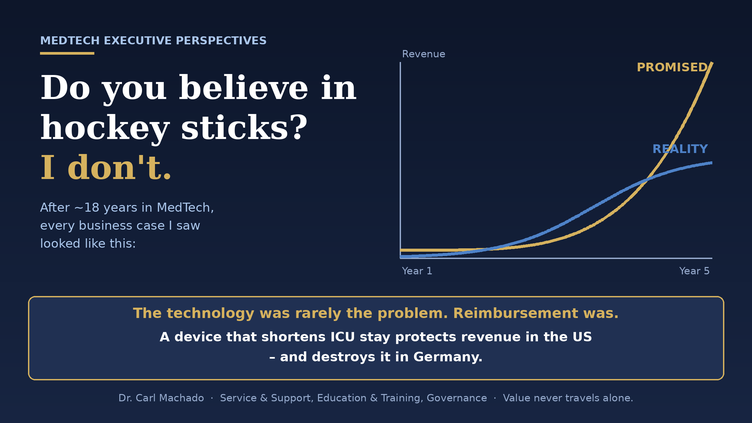
Over 18 years in commercial roles across medical technology, I have reviewed a high number of business cases for launching innovations into new markets. Almost every one of them promised a hockey stick: two modest years, then exponential take-off. Not a single one delivered that curve. Not one.
The reason is rarely the technology. It is the assumption, often unspoken, that success travels – that a product which wins in its home market carries its value proposition across borders like luggage. It does not. Clinical benefit may be universal; economic benefit is not. The same device that saves a hospital money in Boston can erode hospital revenue in Berlin. Understanding why is, in my view, the single most underestimated discipline in MedTech scaling – and the most common reason international expansion destroys value instead of creating it.
A Global Industry, Fragmented by Design
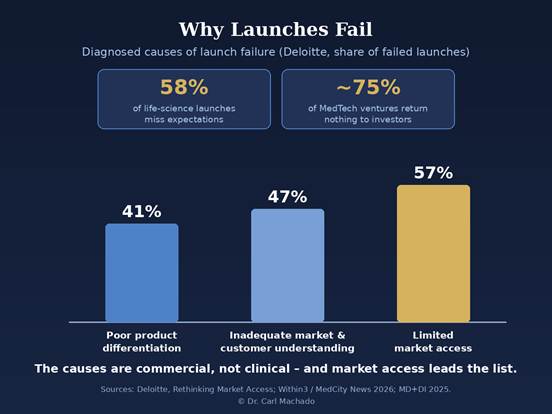
MedTech is a global industry in its research and development, but a profoundly local one in its economics. Industry analyses continue to show that growth leaders are precisely those companies expanding into higher-growth markets – and yet launch performance remains sobering. Recent market-access research puts the share of life-science product launches that miss their expectations at 58 per cent. Some industry estimates suggest that a majority of MedTech ventures fail to generate a return for their investors. Notably, the diagnosed causes are commercial rather than clinical: Deloitte attributes 57 per cent of launch failures to limited market access, 47 per cent to an inadequate understanding of market and customer needs, and 41 per cent to poor product differentiation.
“Limited market access” in Deloitte’s analysis does not mean regulatory failure. It means the product is approved but cannot reach patients on payable terms: no reimbursement code or DRG mapping exists; coverage decisions or health-technology assessments are still pending (in Germany, for instance, an innovation may require multiple NUB application cycles or catalogue revisions before reaching routine reimbursement); payers restrict indications or demand prior authorisation, as is routine in the United States; tender structures and capped hospital budgets lock out newcomers; or the price simply cannot be defended against local benchmarks. In other words, the leading cause of launch failure is precisely the discipline this article is about – and the gap between global ambition and local execution is where most of that value is lost.
Three forces make this gap wider today than a decade ago. First, regulatory divergence: the EU Medical Device Regulation has raised the evidentiary bar for CE marking, while the FDA, NMPA, PMDA and other agencies each follow their own logic, timelines and data expectations. Second, reimbursement systems are diverging rather than converging, as every health system responds to cost pressure with its own incentive architecture. Third, procurement and adoption pathways – value analysis committees, tender structures, hospital group consolidation – differ so fundamentally that a proven go-to-market playbook can be structurally unusable one border away. Against this backdrop, scaling is not a distribution exercise. It is a strategy discipline in its own right.
Thesis 1: Reimbursement Architecture Defines What “Value” Means
Consider two of the world’s largest MedTech markets and one identical innovation: a technology that shortens intensive-care length of stay and time on mechanical ventilation.
In the United States, the picture has two layers. At the level of the individual case, Medicare pays inpatient stays through Medicare Severity DRGs, and ventilation is grouped by a single, sharp threshold: 96 hours. A respiratory case with ventilator support up to 96 hours falls into MS-DRG 208; beyond 96 hours it moves into the higher-weighted MS-DRG 207. The step is binary and unforgiving — if the documented duration is even one hour short of 96, neither the >96-hour procedure code nor DRG 207 can be assigned — and the amounts are material: in one published analysis, a ventilated respiratory case reimbursed as DRG 207 drew over USD 42,000, against roughly USD 14,000 for the same diagnosis treated without intensive ventilation. Crucially, and unlike the German system, the US threshold operates only once, at the bottom. Above 96 hours the payment is effectively capped at DRG 207; there is no further ladder rewarding additional ventilation hours. As in Germany, the threshold attracts intense scrutiny: OIG audits of DRG 207 and 870 have repeatedly identified overpayments — an estimated USD 79 million across one six-year audit window, drawn from a claim population worth USD 3.6 billion — and these sit alongside the retroactive clawback machinery described below.
On top of this case-level payment sits a second layer that increasingly ties money to demonstrated quality — with real teeth. Under the CMS Hospital Readmissions Reduction Program, hospitals with excess readmissions lose up to 3 per cent of their Medicare inpatient payments across all admissions for an entire fiscal year; in fiscal year 2026, roughly 2,400 hospitals are affected by some level of penalty, and in earlier cycles the aggregate annual penalty exceeded half a billion dollars. Value-based purchasing and hospital-acquired condition programmes add further payment at risk. The exposure is also retroactive: Recovery Audit Contractors review paid claims with a look-back period of up to three years and claw money back — with reported recoveries exceeding two billion dollars in fiscal year 2021 and cumulative provider exposure in the high single-digit billions over the programme’s early years.
The two layers point in the same direction. In most standard Medicare DRG cases, where payment above the 96-hour threshold is capped while readmissions, complications and unnecessary bed days can trigger penalties or audit exposure, the economic gradient generally runs towards shorter stays and fewer complications. A technology that verifiably reduces complications, readmissions or unnecessary bed days is therefore not a clinical nicety; it is direct financial protection for the hospital. One caveat matters for market strategy, however: this holds for Medicare and most Medicaid payers, which pay by DRG. Many private US insurers still use negotiated per-diem structures, under which a shorter stay can reduce hospital revenue, although case-based and hybrid payment models are increasingly common. Even within a single country, then, the value proposition flips with the payer.
In Germany, the same innovation meets a very different logic. The aG-DRG system assigns ventilated patients to reimbursement classes along defined ventilation-hour thresholds – above 95, 249, 499 or 999 hours, a case moves into progressively higher-paid DRGs, and long-term ventilation beyond 95 hours triggers grouping into dedicated ventilation DRGs that are largely independent of the primary diagnosis. The financial steps are anything but marginal. At the 2025 federal base rate of EUR 4,394 per relative-weight point, the ventilation DRGs of the aG-DRG catalogue 2025 form a steep revenue ladder, with illustrative case values ranging from roughly EUR 11,000 to over EUR 180,000 depending on ventilation duration, severity and procedures; beyond 249 hours (A11) roughly EUR 20,000 to EUR 80,000; beyond 499 hours (A09) roughly EUR 37,000 to EUR 97,000; beyond 999 hours (A07) roughly EUR 45,000 to EUR 142,000; and extreme long-term ventilation beyond 1,799 hours (A06) approximately EUR 187,000 per case.
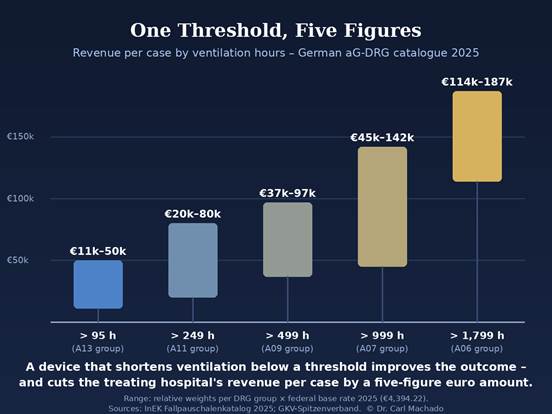
Whether a case lands just above or just below one of these thresholds can therefore shift its revenue by a five-figure euro amount at comparable clinical severity. A technology that shortens ventilation from just above a threshold to just below it consequently reduces the treating hospital’s revenue, case by case. The clinical outcome is better; the economic outcome, for the adopting customer, is worse. Add the discount mechanics of minimum length-of-stay rules, and “faster discharge” becomes a value proposition that must be argued with great care – towards capacity utilisation, staff scarcity and case-mix strategy rather than towards revenue per case.
Economically, this creates a marginal incentive at the threshold: while additional ventilation time within a band does not increase reimbursement, crossing the threshold does. A technology that reduces ventilation duration from just above to just below such a threshold may therefore improve clinical outcomes while negatively affecting revenue in the individual case. A technology that achieves precisely those five hours earlier works clinically for the patient and economically against its customer. It is no coincidence that ventilation duration has been a standing audit focus of the Medizinischer Dienst for years, with every disputed hour potentially worth a five-figure amount. Nor is the macro picture reassuring at first glance: analyses of Federal Statistical Office DRG data show that since the introduction of DRGs in Germany, both the number of ventilated patients and total ventilation hours have risen markedly – while mortality declined – a development recurrently debated as evidence of revenue-driven treatment. In fairness, the same peer-reviewed analysis found no evidence that ventilation durations actually cluster around the grouping-relevant thresholds; better survival, less invasive methods and an ageing population explain much of the rise. But the debate itself illustrates the point: where payment architecture and clinical practice are this tightly coupled, no manufacturer can afford to argue value without understanding the coupling.
The conclusion, however, is not that such an innovation has no value proposition in Germany. It is that the hospital may not be the economically primary beneficiary. The stakeholders who demonstrably benefit from a shorter intensive-care stay are the payers – the statutory and private insurers who fund those five-figure DRG cases and who ought to take a keen interest in any technology with robust evidence of length-of-stay reduction. Reaching them is not a sales task but a business-development discipline: structured, long-cycle dialogue with payer organisations, conducted jointly and in tight coordination by reimbursement specialists and clinical experts who can hold both the health-economic and the medical side of the conversation at once. And the differentiation does not stop at the payer. Provider structures matter equally: an accident-insurance-funded BG clinic, a publicly owned municipal hospital and a private hospital group each operate under different funding logics, investment constraints and incentive structures, and each will weigh the same technology differently. In practice, then, there is not merely one value proposition per country – there is one per payer, and often one per provider category.
Same device. Same evidence. Opposite economics. This is why market prioritisation exercises built on epidemiology and market size alone are structurally naive, and why local health-economics and reimbursement specialists – alongside genuinely local marketing – are not overhead. They are the difference between a value proposition and a liability. No headquarters function, however sophisticated, can substitute for someone who knows how a specific health system actually pays.
The core principle
An innovation does not have a value proposition. It has one per payer and per provider category within each reimbursement system – and each must be built, evidenced and argued locally.
Thesis 2: Regulatory Approval Is a Checkpoint, Not a Strategy
Executives routinely conflate market entry with market access. CE marking under MDR, FDA clearance or approval, and their equivalents elsewhere are necessary conditions – nothing more. They entitle a company to sell; they do not cause anyone to buy, and they certainly do not cause anyone to pay.
The independent, multicentre clinical study remains the backbone of credibility, and it should be exactly that: independent. But it is not sufficient. Payers, hospital managements and increasingly clinicians themselves ask a second question: what does this technology do to our economics, in our system, under our payment rules? That question can only be answered with local evidence – health-economic analyses and, ideally, local clinical studies designed from the outset to capture economic endpoints alongside clinical ones: length of stay, resource utilisation, staffing impact, complication-related costs, penalty exposure. Companies that plan evidence generation market by market, rather than assuming one flagship trial will carry the world, consistently achieve faster and more durable adoption. Those that do not spend years explaining to sceptical procurement committees why data from a foreign system should be believed.
Thesis 3: Scale Through Credibility, Not Coverage
The most reliable scaling pattern I have seen – repeatedly, across product categories – is deliberately unspectacular. It starts small: a pilot at a limited number of carefully chosen clinics, with clinical opinion leaders who are genuinely engaged rather than merely contracted, and who run their own independent studies on the technology’s effectiveness. Their results are presented by them, at their congresses, in their language. Credibility is created where it cannot be bought.
Choosing those pilot sites is not a matter of convenience or existing relationships. A disciplined customer segmentation should explicitly identify early adopters – the innovation-minded clinicians and institutions with a documented appetite for being first – and treat them as preferred customers for the initial phase. They tolerate the imperfections of a first-generation product, contribute actively to its refinement, and lend their credibility to the emerging evidence base. The pragmatic majority, by contrast, follows references, not brochures – which is exactly why sequencing matters: sell first to those who want to innovate, so that later you can sell to those who want certainty.
From there, the expansion follows the adoption hierarchy of the market: university hospitals next, establishing academic reference sites – ideally ones that have documented not only clinical but also economic outcomes. Then, and only then, the broader base of smaller regional and district hospitals, who adopt with confidence because a reference institution they respect has demonstrated that the technology works clinically and pays off economically. This sequence cannot be compressed by marketing spend. It can, however, be destroyed by impatience – by flooding a market with sales representatives before the reference architecture exists.
The commercial structure must fit the same logic. Direct sales forces, distributor models and hybrid constructions each have their place, but the choice is a strategic one: it determines who owns the customer relationship, who controls clinical training and service quality, and who captures the margin that funds local evidence generation. A distributor appointed to save fixed cost, then left unmanaged, is one of the most expensive savings in this industry. Business development, key-account structures for consolidating hospital groups, tender competence and post-sale service capability all need to be designed for the specific market – not inherited from the last one.
Thesis 4: The Courage to Stay – and the Courage to Leave
Scaling requires two kinds of courage, and most organisations possess at most one of them.
The first is the courage to plan realistically and hold the line. International adoption in MedTech follows the slow arithmetic of evidence, references and trust – typically years, not quarters. A realistic, ambitious growth plan beats a heroic one, because the heroic one collapses at the first budget review and takes the market commitment down with it. When I say that none of the hockey-stick business cases I have reviewed ever materialised, the point is not cynicism. The point is that hockey-stick planning systematically produces premature disillusionment, and premature disillusionment kills ventures that honest planning would have carried to profitability.
The second is the courage to leave. Political and reimbursement conditions change: tariffs are restructured, coverage decisions reversed, procurement nationalised, market access rendered structurally unprofitable. And the trigger is not always political – markets can be redrawn by clinical substitution. In a business serving the bariatric-surgery field, I tracked the rise of GLP-1 medications very closely; companies in that space must be honest with themselves that if market conditions shift, patients will understandably prefer a less invasive pharmacological therapy over a surgical one. Monitoring such substitution dynamics is as much a part of scaling governance as monitoring tariffs. When conditions do turn – and a disciplined review after three to four years is the right moment to ask – the willingness to withdraw from a market is not defeat but governance. It may sound hard. But medical technology development must ultimately pay for itself; the margins earned in viable markets are what fund the next generation of innovation, and capital held hostage in structurally unprofitable geographies serves neither patients nor shareholders. Exit criteria should be defined at entry, in writing, when nobody is emotionally invested yet. They rarely are.
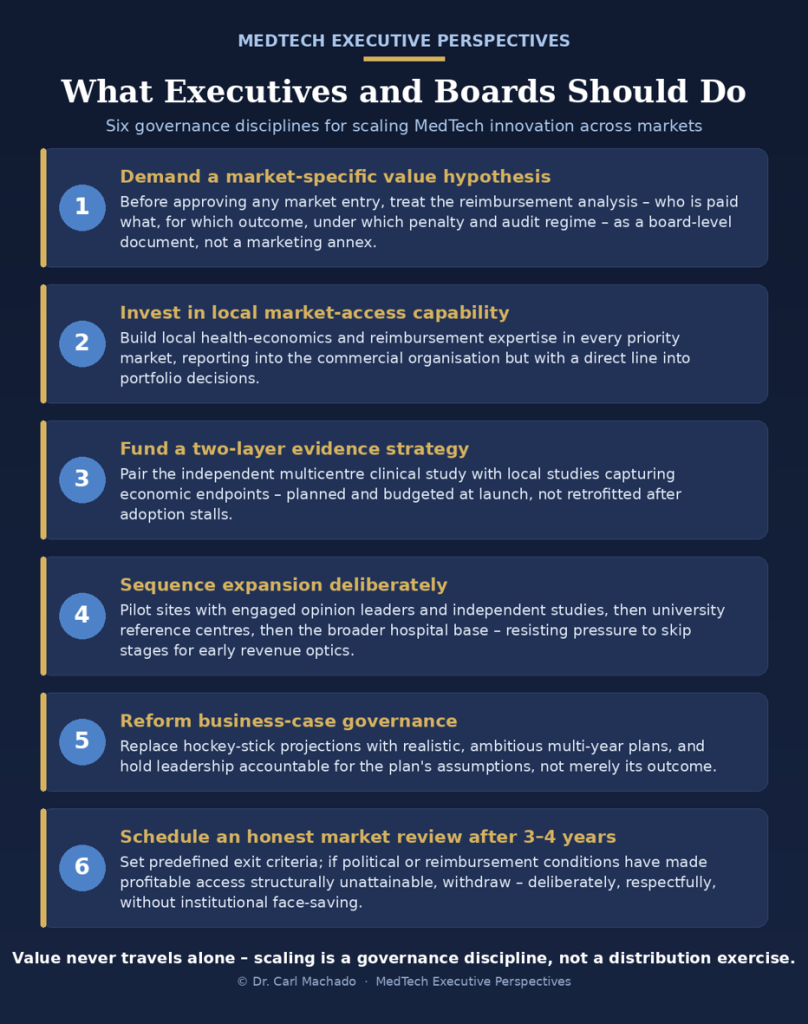
What Executives and Boards Should Do
Risks, Limits and Familiar Traps
Five pitfalls deserve explicit mention:
- The copy-paste trap. Transplanting a successful go-to-market model into a new market because it worked elsewhere – the more successful the home market, the stronger the gravitational pull.
- The flagship-evidence trap. Assuming that data generated in one system will persuade payers in another; it rarely does, and insisting on it reads as arrogance.
- The distributor set-and-forget trap. Outsourcing a market and then being surprised that neither clinical training nor evidence generation nor brand equity exists there five years later.
- The sunk-cost trap. Persisting in markets that will never pay because too much has already been invested and too many careers are attached to the entry decision.
- The premature-exit trap. The mirror image: abandoning a market in year two, precisely when honest planning would have predicted the slow phase – thereby confirming the hockey-stick fallacy in reverse.
A final caveat: reimbursement systems are slowly moving targets. Optimising a value proposition too tightly to today’s tariff logic – a threshold, a code, a penalty formula – creates fragility, because these parameters change. The durable position is clinical benefit plus economic adaptability: evidence architectures broad enough to be re-argued when the payment rules shift. Scaling MedTech innovation is, in the end, not about believing in one’s product. It is about respecting the systems that decide what that product is worth – market by market.
Sources
Centers for Medicare & Medicaid Services (CMS). Hospital Readmissions Reduction Program (HRRP). Programme methodology; payment adjustment capped at 3 per cent of Medicare inpatient payments.
KFF – Kaiser Family Foundation. Aiming for Fewer Hospital U-turns. Aggregate HRRP penalties of USD 528 million (FY 2017); approx. 78–79 per cent of hospitals penalised.
LegalClarity, citing CMS FY 2026 IPPS data. Approx. 2,400 hospitals subject to HRRP payment reductions in FY 2026.
CMS / industry analyses of the Recovery Audit Contractor (RAC) programme. Three-year look-back period; recoveries exceeding USD 2 billion in FY 2021; cumulative provider liability of approx. USD 8.9 billion (2010–2015).
InEK – Institut für das Entgeltsystem im Krankenhaus. aG-DRG-System 2025 (Fallpauschalenkatalog 2025). Grouping-relevant ventilation-hour thresholds (>95, >249, >499, >999, >1,799 hours); relative weights of the ventilation DRGs A13 (2.6–11.4), A11 (4.5–18.1), A09 (8.4–22.2), A07 (10.3–32.3) and A06 (up to 42.6).
GKV-Spitzenverband / DKG / PKV. Bundesbasisfallwert 2025: EUR 4,394.22 per relative-weight point (2026: EUR 4,570.64); basis of the euro figures cited.
Die Anaesthesiologie / Springer (2016). Analysis of Federal Statistical Office DRG statistics and InEK data (2005–2012). Marked rise in ventilated patients and ventilation hours since DRG introduction alongside declining mortality; no evidence of clustering of ventilation durations at grouping-relevant thresholds.
Within3 / MedCity News (2026). 58 per cent of life-science launches miss expectations.
Deloitte. Rethinking Market Access. 57 per cent of launch failures attributed to limited market access, 47 per cent to inadequate understanding of market and customer needs, 41 per cent to poor product differentiation.
MD+DI (2025). Approx. 75 per cent of MedTech ventures fail to generate a return for investors.
EY. Pulse of the MedTech Industry 2025. Growth leadership driven by differentiated innovation and expansion into higher-growth markets.
IQVIA MedTech (2025). Comprehensive Market Access in MedTech. Market prioritisation, stakeholder engagement and reimbursement mapping framework.
Regulation (EU) 2017/745 on medical devices (MDR).
About the Author
Dr. Carl Machado is a global executive with responsibility for Service & Support, Education & Training, and Governance in a leading MedTech company. With 18 years of commercial leadership experience at Philips, Johnson & Johnson, and corpuls, he writes on service strategy, salesforce effectiveness, organisational governance, and the intersection of clinical practice and commercial performance.