The Hidden Cost of Service Outsourcing – What margin gains really buy — and what they quietly sell
Disclaimer: The articles reflect general industry examples or topics only and do not refer to, represent, or imply any current or former employer, unless expressly stated otherwise.
The Question Nobody Could Answer
An inspector asks a simple question during a routine audit: who performed the last preventive maintenance on this device, and to what specification?
There are four people in the room. None of them can answer. The device sits in a customer account that has been serviced under a partner arrangement for three years. The maintenance record exists — somewhere — in the partner’s field system, in the partner’s format, generated under the partner’s quality management system. Assembling the answer takes eleven days.
The device was fine. The maintenance had been performed correctly. Nothing had gone wrong clinically, and nothing did. What had gone wrong was the ability to demonstrate control — which, in a regulated industry, is not a lesser failure.
The composite is unremarkable, and that is the point. Most organisations that have outsourced field service can produce a version of it. The finance case for the arrangement had been rigorous: unit costs modelled, coverage mapped, savings validated. The governance case had never been made, because nobody had been asked to make one.
| The central claim Service outsourcing in MedTech is routinely evaluated as a procurement decision. It is a governance decision. The distinction is not semantic — it determines which costs appear in the business case and which do not. |
Why the Question Is Live Now
Three pressures are converging on the make-or-buy decision in MedTech service, and they push in different directions. Any executive treating this as a settled question is probably working from a stale answer.
Cost pressure is structural, not cyclical
Regulatory compliance costs under MDR, reimbursement pressure in major markets, and sustained procurement sophistication on the hospital side have compressed margins across most device categories. Service, as one of the few lines with genuine margin headroom, attracts attention. When a CFO looks for structural cost reduction, a field organisation with fixed headcount and geographic overhead is a visible target.
The field workforce is genuinely scarce
This is the pressure most often understated in boardroom discussion, and it is the one that makes the case for partnering strongest. The talent pipeline for field-capable engineers is contracting across Europe, and demography guarantees it will contract further.
In Germany — the continent’s largest MedTech market and its largest pool of technical labour — the Institut der deutschen Wirtschaft put the shortfall in MINT occupations at roughly 134,000 in its spring 2026 report, with technical professions persistently among the widest gaps. The feed is thinning at the source: according to the Federal Statistical Office, first-year enrolments fell by 29 per cent in mechanical engineering and 25 per cent in electrical engineering over the five years to 2022, a decline the VDMA has repeatedly flagged as structural. And the problem is not German alone: in ManpowerGroup’s EMEA-wide survey of roughly 13,000 employers, 53 per cent reported difficulty filling roles, with technicians and engineers consistently among the hardest to recruit. The demographic driver — a retiring cohort larger than the one replacing it — applies to a MedTech field organisation exactly as it applies to everyone competing for the same engineers.
An organisation cannot govern its way out of a labour market. If the engineers do not exist, no amount of insourcing conviction will produce them.
The sourcing pendulum has already swung back
Deloitte’s 2024 Global Outsourcing Survey, covering more than 500 senior executives, found that 70 per cent had selectively brought back in-house scope that had previously sat with a third party over the preceding five years — typically less than a quarter of total scope, which suggests correction rather than reversal. In the same body of work, the share of organisations citing cost reduction as the primary outsourcing driver fell to 34 per cent, from 70 per cent in 2020.
The reading is not that outsourcing failed. It is that cost-led outsourcing decisions have proven unreliable often enough that experienced buyers have stopped making them on that basis alone.
The Principle That Changes the Calculation
There is a fact about medical device regulation that ought to sit at the centre of every service sourcing discussion, and rarely does.
Under Article 10 of the EU Medical Device Regulation, a manufacturer’s quality management system must cover the control of suppliers and subcontractors as an explicit element. ISO 13485:2016, Clause 7.4, requires documented criteria for the evaluation, selection, monitoring and re-evaluation of suppliers, with the depth of control proportionate to the risk the supplied product or service poses to device safety and performance. The FDA’s supplier control provisions run in parallel.
The consequence is unambiguous. Delegating an activity does not delegate responsibility for it. The manufacturer remains answerable for the safety and performance of the device irrespective of whose engineer performed the work, and remains obliged to evidence that it exercised control over the party that did.
| Restated for the board pack Outsourcing transfers execution. It does not transfer accountability. The correct question is therefore not “can a partner perform this activity at lower unit cost?” It is: “can we still evidence control, capture the regulatory record, and retain the signal — when a partner performs it?” Those are different questions, and they produce different answers. |
What Rolls-Royce Understood: No Data, No Service
The most instructive service model of the past six decades was built in Derby, not in a MedTech boardroom — and its central lesson is about data, not maintenance.
Rolls-Royce has sold engine availability rather than engine repairs since the 1960s, first as Power by the Hour and later as TotalCare: airlines pay a rate per engine flying hour, and the manufacturer assumes responsibility for keeping the engine on the wing. What makes that promise commercially survivable is not a larger workshop network. It is Engine Health Monitoring — a continuous stream of in-flight telemetry, analysed centrally, that lets Rolls-Royce predict when a component will need replacement rather than respond after it fails, and forecast maintenance demand across entire fleets years in advance. In its current form the engine can even respond to a request from the operations centre and return hundreds of hours of data on a specific part or parameter.
The point for MedTech executives is the architecture, not the aerospace. Rolls-Royce distributes execution — shop visits and overhauls run through a certified maintenance, repair and overhaul network, much of it not owned by Rolls-Royce. But the data, the health-monitoring algorithms and the analytical capability never left the manufacturer. Execution is shared; the foundation is not. That is precisely the inverse of the naive outsourcing pattern, in which the manufacturer keeps a brand and a contract while the partner accumulates the operating data.
| The transferable principle Preventive maintenance — and every service model built on top of it, from uptime guarantees to outcome-linked pricing — requires continuous access to device data. Access to the data of the installed base is the foundation of any service activity. A sourcing decision that transfers the field activity without contractually securing the data pipeline has not outsourced a cost line. It has surrendered the foundation on which the next decade of service revenue was supposed to be built. |
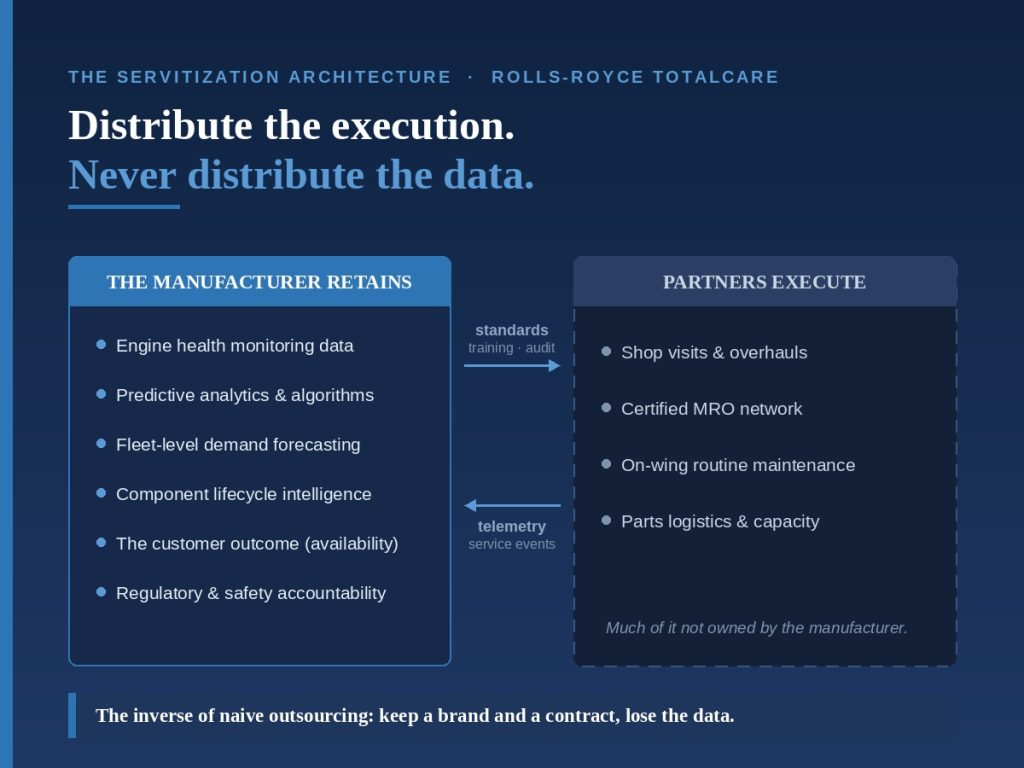
This is not a distant analogy for MedTech. Imaging fleets, ventilators, monitoring platforms and laboratory analysers increasingly carry the same telemetry capability that made TotalCare possible. Whether the manufacturer can actually use it depends on decisions that look procedural at the time they are made: who installs the connectivity, whose system captures the service event, in what format the record is returned, and who holds the contractual right to the data stream. Each of those is routinely settled inside an outsourcing agreement — usually by whoever is optimising for unit cost.
Four Costs That Rarely Reach the Business Case
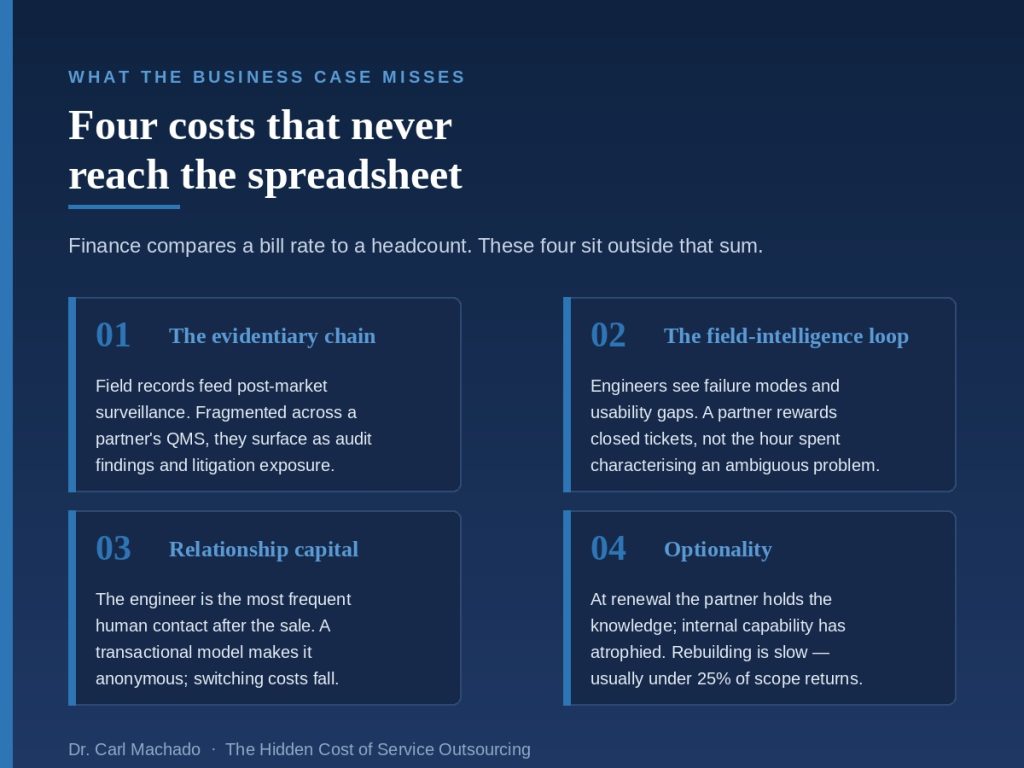
1. The evidentiary chain
Field service in MedTech is not adjacent to regulatory compliance; it is one of its primary collection points. Preventive maintenance, calibration, software deployment, log retrieval and installation verification all generate records that feed post-market surveillance obligations and, when something goes wrong, the reconstruction of what happened.
When the activity moves to a partner operating under its own QMS, the record does not disappear — it fragments. It may be technically compliant with ISO 13485 while remaining structurally incompatible with the manufacturer’s own procedures, escalation thresholds and documentation standards. Data that should flow automatically into a surveillance file instead requires translation, re-entry, or a request.
The cost surfaces in three places: audit findings and the corrective actions they trigger; the time and expense of reconstructing facts during a complaint investigation; and, in litigation, the impression created when service records for a device involved in patient harm turn out to be scattered across two organisations with gaps at the seams. Whether or not that impression is legally fair, it shapes how the company’s safety culture is read.
2. The field intelligence loop
A well-constituted field organisation functions as a distributed sensing network. Engineers see devices under real clinical conditions: the workarounds users have developed, the alarm that gets silenced by default on a particular ward, the mounting configuration nobody anticipated, the failure mode that is trivial in one setting and critical in another.
An internal engineer typically has both the route and the incentive to escalate that observation. A partner engineer usually has neither. The commercial model rewards closed tickets and met SLAs, not the hour spent characterising an ambiguous usability problem. More fundamentally, a generalist technician may lack the clinical context to recognise that what looks like user error is, in aggregate, a design assumption failing against actual practice.
The consequence is slow and hard to attribute: product roadmaps built on internal assumption rather than field reality, improvements that address the wrong problems, and competitors with tighter feedback loops iterating faster on the same installed base.
3. Relationship capital
In many segments, the service engineer is the most frequent human contact a customer has with the manufacturer after the sale. Those visits carry information in both directions — early signals of dissatisfaction, awareness of an upcoming tender, knowledge of which clinician actually influences the purchasing decision.
Under a transactional partner model, continuity is typically the first casualty. A different engineer each visit, no site memory, scheduling optimised for the partner’s route density rather than the customer’s clinical rhythm. The relationship becomes competent and anonymous. Switching costs fall accordingly, and retention economics deteriorate quietly, over a horizon longer than the one on which the outsourcing decision was judged.
4. Optionality
At signature, both parties are motivated. At renewal, the position is asymmetric. The partner has trained engineers on the product, built route density, and accumulated the operating knowledge. The manufacturer has allowed internal capability to atrophy: no hiring, no training pipeline, no bench.
Rebuilding is slow and expensive — which is consistent with the Deloitte finding that repatriation, when it happens, usually covers less than a quarter of scope. Organisations do not reverse these decisions cleanly; they reverse the parts they can. Meanwhile the ability to experiment with new service models — remote monitoring, uptime guarantees, outcome-linked pricing — is constrained by whatever the contract happens to permit.
The Case For Outsourcing, Taken Seriously
An argument that only runs one way is not useful to a board. There are conditions under which partnering is not merely defensible but clearly correct.
- Coverage that cannot otherwise exist. Given the workforce figures above, a partner network is frequently the only realistic route to acceptable response times across dispersed geographies or sub-scale markets. A slower internal engineer is not superior to a faster external one.
- Demand variability. Installation surges, recall campaigns, fleet upgrades and seasonal peaks are poorly served by fixed headcount sized for the average.
- Genuinely standardised work. Where a task can be fully specified, trained to, and verified — routine inspection, consumable replacement, minor software deployment — the argument for performing it internally is largely sentimental.
- Competence is not conferred by an employment contract. A well-trained, well-supervised partner engineer working to a rigorous quality agreement will outperform an under-trained internal one. Insourcing is not a substitute for training standards, and treating it as one is its own failure mode.
The objection in this article is not to partnering. It is to partnering decisions made on unit cost alone, without an explicit judgement about which activities carry regulatory evidence, clinical signal, or the customer relationship.
Drawing the Line: Four Tests
Rather than a blanket position, the practical instrument is a test applied activity by activity. Retain the activity internally if the answer to any of the following is yes.
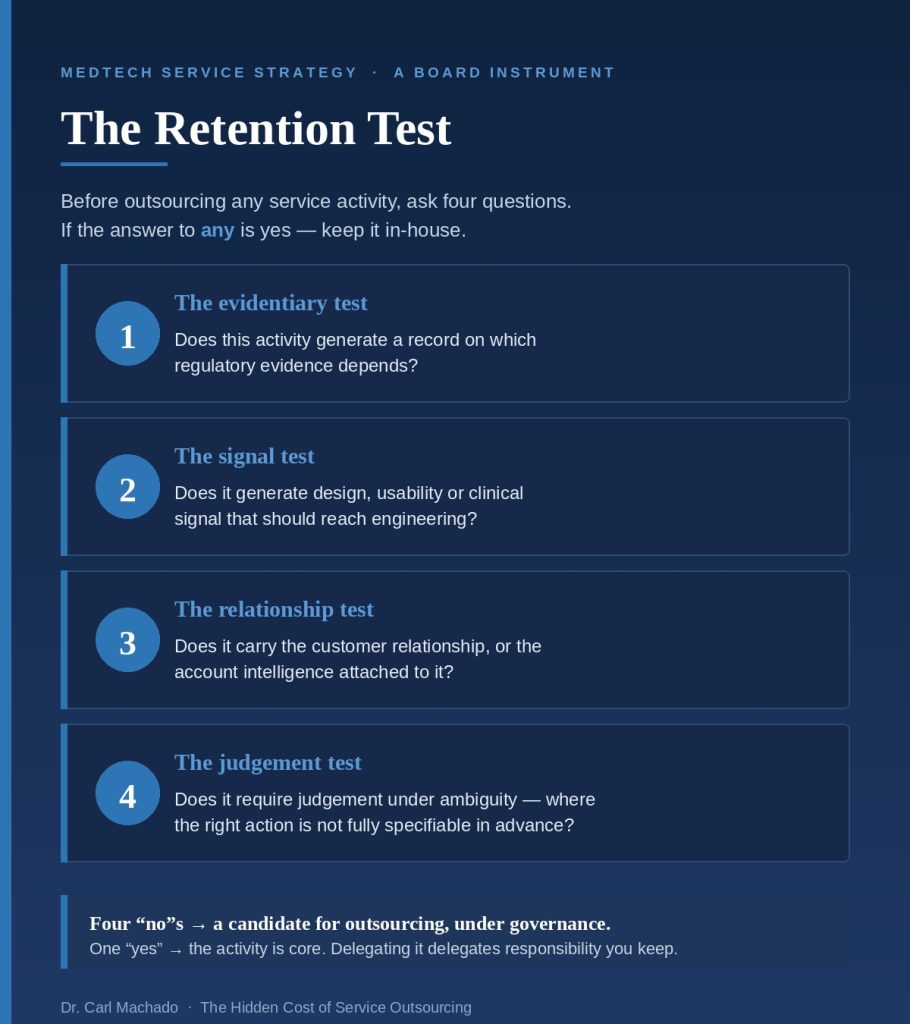
Applied honestly, this test usually retains complex troubleshooting, clinical integration and workflow support, compliance-sensitive documentation and escalation, and the escalation relationship with strategic accounts. It usually releases routine preventive inspection, consumable and non-critical parts replacement, logistics-heavy activity, and surge capacity.
The resulting structure is not a binary. It is a lean, expert internal function that sets standards, trains and audits partners, owns escalation and the clinical feedback route — with execution capacity supplied through partners under active governance. That model costs more than full outsourcing. It costs considerably less than the alternative of discovering, three years in, that nobody owns the evidence.
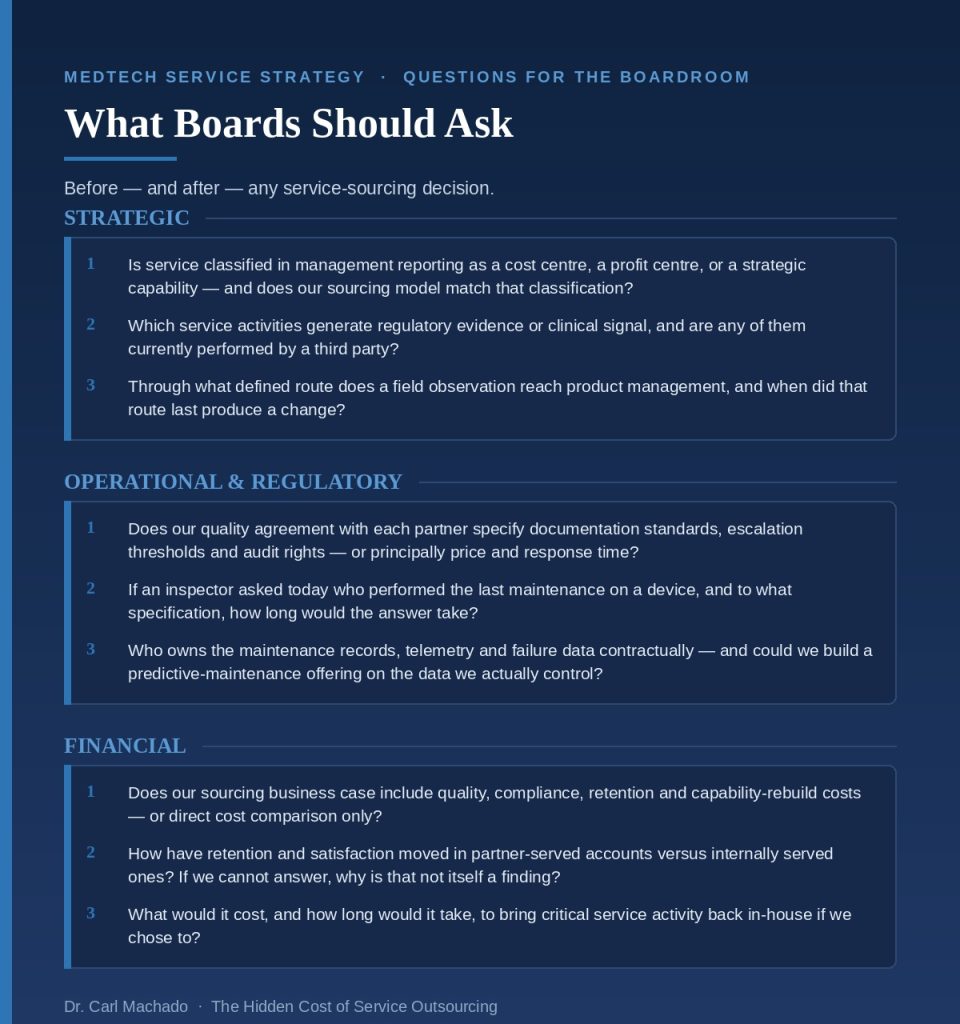
What Boards and Executives Should Ask
Three Ways This Goes Wrong
Even organisations that reach the right structural conclusion tend to fail in predictable ways during execution.
1. The quality agreement that is really a price list
Contracts negotiated by procurement optimise for what procurement is measured on. Unless quality and regulatory functions hold genuine sign-off authority — not consultation — the document that governs a regulated activity will end up specifying commercial terms in detail and quality obligations in generalities.
2. Measuring the partner on compliance rather than outcome
SLA attainment is easy to measure and weakly correlated with what matters. A partner can hit every response-time target while first-time fix rates decline, repeat visits rise and customers quietly disengage. If the scorecard contains only what is contractually convenient, it will report success through the period in which the relationship deteriorates.
3. Falling below the intelligent-client threshold
This is the most consequential and the least visible. Governing a technical partner requires enough retained expertise to know when the partner is wrong. Once internal capability erodes past that point, oversight becomes ceremonial — reviewing reports the organisation is no longer competent to challenge. Capability is not merely an execution resource; it is the precondition for governing anyone else’s.
Closing
Service is shifting from cost line to strategic asset across much of European MedTech. The direction of travel is visible in public reporting: Siemens Healthineers describes its recurring business as the stable foundation from which growth is pursued, and has built a portfolio of more than 200 long-term Value Partnerships that deliberately reshape equipment sales into multi-year service relationships. That is the TotalCare logic arriving in healthcare — and it depends on the same foundation. Where remote monitoring, predictive maintenance and outcome-linked contracting take hold, the organisation that controls the installed-base data controls the service model built on it.
That does not argue for insourcing everything. It argues for deciding deliberately. The question is not whether to use partners — most organisations must, and the workforce arithmetic will make that more true, not less. The question is where the line falls, and whether the organisation has drawn it on the basis of regulatory evidence, clinical signal and relationship value, or on the basis of unit cost alone.
Get the line right and partnering becomes an instrument of operational efficiency. Get it wrong and the organisation will have optimised a cost line while selling, at a price it never calculated, the capability on which its regulatory standing and its customer relationships rest.
Sources and References
Regulation (EU) 2017/745 (MDR), Article 10 and Annex IX. General obligations of manufacturers; quality management system requirements including control of suppliers and subcontractors, and post-market surveillance obligations.
https://eur-lex.europa.eu/eli/reg/2017/745/oj
ISO 13485:2016, Clause 7.4. Purchasing and supplier control: documented criteria for the evaluation, selection, monitoring and re-evaluation of suppliers, proportionate to risk. Harmonised under Commission Implementing Decision (EU) 2022/6.
https://www.iso.org/standard/59752.html
21 CFR 820.50 (US FDA). Purchasing controls; parallel supplier qualification and control obligations for devices marketed in the United States.
https://www.ecfr.gov/current/title-21/chapter-I/subchapter-H/part-820/subpart-E/section-820.50
Deloitte, Global Outsourcing Survey 2024. Survey of more than 500 senior business and technology executives. 70 per cent reported selectively insourcing previously outsourced scope over the preceding five years, typically under 25 per cent of total scope; cost reduction cited as the primary outsourcing driver by 34 per cent, down from 70 per cent in 2020.
https://www.deloitte.com/us/en/services/consulting/articles/global-outsourcing-survey.html
Institut der deutschen Wirtschaft (IW), MINT-Frühjahrsreport 2026. Aggregate shortfall of 133,900 workers across MINT occupations in Germany as of March 2026, with engineering, energy/electrical, metalworking and construction trades among the most affected.
https://www.iwkoeln.de/studien/christina-anger-julia-betz-wido-geis-thoene-axel-pluennecke-arbeitsmarktbericht-beschaeftigungsperspektiven-in-mint.html
Verband Deutscher Maschinen- und Anlagenbau (VDMA) / Statistisches Bundesamt. First-year student enrolments in Germany fell 29 per cent in mechanical engineering and 25 per cent in electrical engineering over the five years to 2022.
https://www.vdma.eu/fachkraefte
ManpowerGroup, Global Talent Shortage 2024. Employer survey on difficulty filling roles due to lack of qualified talent; skilled trades, technicians and engineers consistently among the hardest-to-fill positions in EMEA.
https://go.manpowergroup.com/talent-shortage-2024
Rolls-Royce plc, TotalCare® and Engine Health Monitoring. Availability-based service model charged per engine flying hour, originating in the Power by the Hour concept of the 1960s; continuous engine telemetry enabling component replacement to be predicted rather than reactive; execution distributed across a wide range of suppliers and a certified MRO network while data and analytics remain with the manufacturer.
https://www.rolls-royce.com/products-and-services/civil-aerospace/services/totalcare.aspx
Siemens Healthineers AG, Capital Market Day 2025 / Annual Report 2025. Recurring business described as the stable profit foundation of the group; more than 200 Value Partnerships with major customers worldwide as a source of recurring revenue.
https://www.siemens-healthineers.com/press/releases/cmd2025
ABOUT THE AUTHOR
Dr. Carl Machado is a global executive with responsibility for Service & Support, Education & Training, and Governance in a leading MedTech company. With 18 years of commercial leadership experience at Philips, Johnson & Johnson, and corpuls, he writes on service strategy, salesforce effectiveness, organisational governance, and the intersection of clinical practice and commercial performance.