The Talent Pipeline Nobody Audits – A Vanishing Expertise Base as a Business Risk
Boards audit supply chains, manufacturing quality, regulatory compliance and financial controls. Almost none audit where field service expertise lives — or whether it will still be there in eighteen months. This article argues that the service talent pipeline is an operational and financial risk, not an HR topic. European labour-market data now makes the external pressure quantifiable rather than anecdotal. The company-specific exposure still has to be calculated from internal service and customer data.
The board question is not whether service matters. It is whether the service talent pipeline is governed with the same rigour as every other critical function. In most companies, it is not.
Disclaimer: Unless explicitly stated otherwise, these articles are based on general industry examples and topics only and do not relate to, represent, or imply any current or former employer.
The Service Tetris: When Expertise Disappears
A mid-sized medical device company. A regional service manager calls the head of field operations. On the line, urgency.
“We’ve lost John, one of our senior field engineers. He’s taken a role with a competitor, moving away in 2,5 months. It will be hard to cover his excellent work.”
The operations head nods knowingly. They have been through this before. What follows is not reassurance — it is a cascade of uncomfortable realisations. The Service Tetris begins.
After leaving, within forty-eight hours, the first customer problem lands. An ICU’s ultrasound device is malfunctioning. The PACS integration has broken. Clinical staff cannot find the images where they expect them. Someone must fix it — not remotely, but on site, where the problem lives in the actual clinical workflow and operating constraints.
The junior engineer assigned to cover the gap pulls the digital work order. It contains a brief description: “PACS integration issue. Check connection layer.”
What it does not contain — what nobody thought to document — is that at this particular hospital the PACS integration only works if you physically restart the connection hub in the IT closet on the third floor. The IT director’s direct line is not in the CRM. The code to unlock the closet is not recorded. The fact that you must coordinate with the IT manager before restarting, because there is a scheduled backup every morning at 10, is written nowhere.
The departing engineer knew this. He knew it the same way he knew to bring the right adapter cable, and where the IT director loves spending his holidays. His knowledge lived in his head. When he left, it departed with him.
Three hours later, the junior engineer is still problem-solving on the phone. The scan schedule is behind – a competitive devices is serving as a replacement. The hospital’s frustration is growing. The customer — who spent six months deciding whether to replace their previous system — is reassessing that decision.
This is Service Tetris. The gap left by an experienced operator looks like a small, abstract loss until the blocks fall.
The Hidden Board Risk
Most boards audit supply chains, manufacturing quality, regulatory compliance and financial controls. They ask hard questions about inventory, liability and competitive positioning.
In many organisations, board-level reporting does not make visible where critical field-service expertise resides — or whether it will still be available in eighteen months.
This is not a soft HR problem. Field service engineers and other specialised MedTech roles can be critical to customer retention, reliable device operation, complaint handling and, where their work affects regulated processes, regulatory compliance.
Yet almost every medical device organisation operates as if their expertise will be perpetually available, indefinitely replaceable and self-documenting.
It is none of those things. And unlike a decade ago, the exposure can now be described with public European data rather than assertion.
The European Baseline: What the Data Shows
Replacement demand, not growth, is the driver
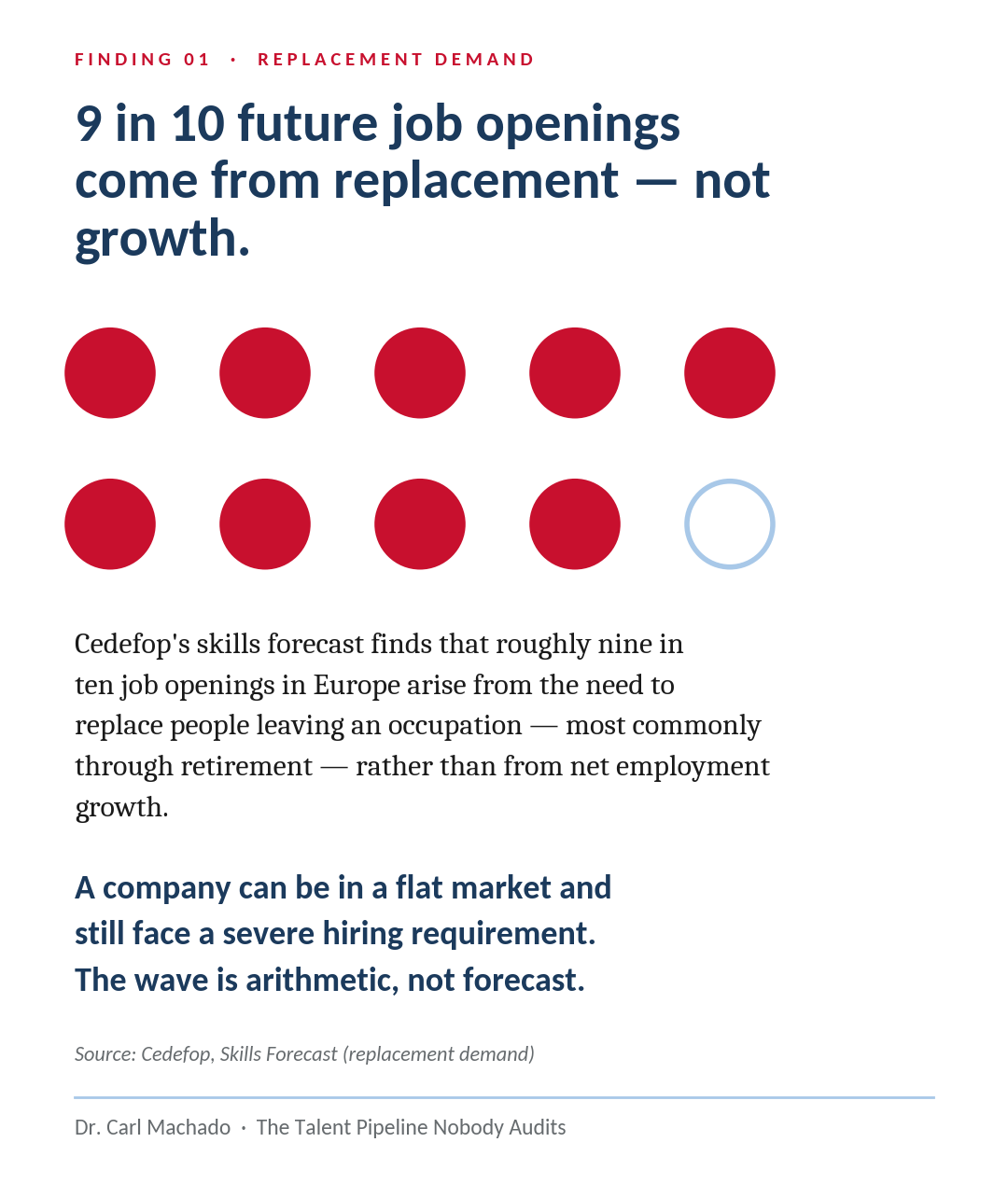
The most consequential fact for workforce planning in Europe is also the least discussed in boardrooms. In Cedefop’s European skills forecast, roughly nine in ten projected job openings over the forecast period are associated with replacement demand — vacancies created as people leave employment — rather than net employment growth.
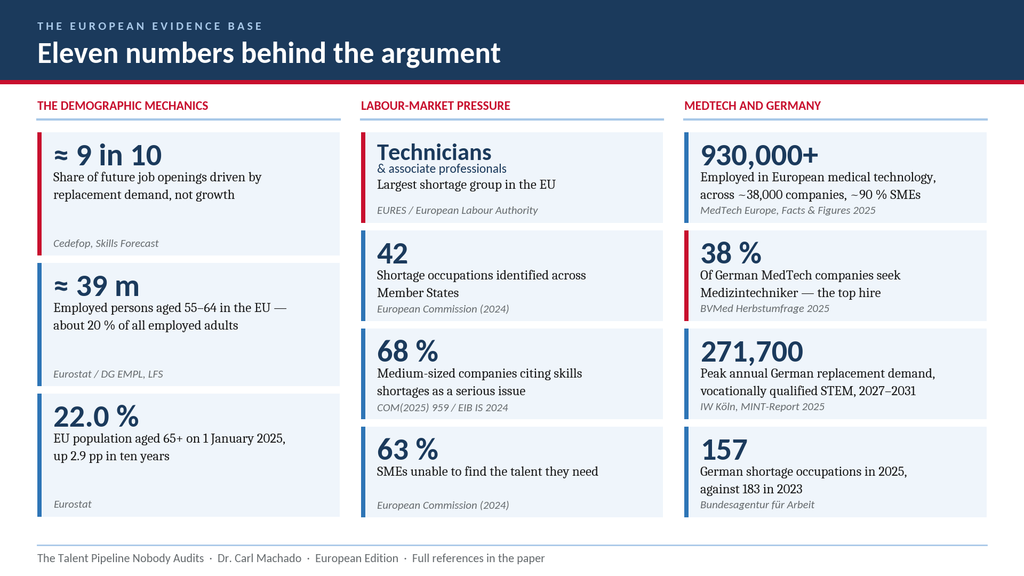
The demographic base is unambiguous. In the cited European Commission analysis, around 39 million people aged 55–64 were employed in the EU, representing approximately 19.9 per cent of total employment. On 1 January 2025, people aged 65 and over made up 22.0 per cent of the EU population, up 2.9 percentage points in a decade, and the old-age dependency ratio is projected to rise steeply to 2050. The cohort now holding the deepest field experience is the cohort now closest to the exit.
The shortage is concentrated exactly where service lives
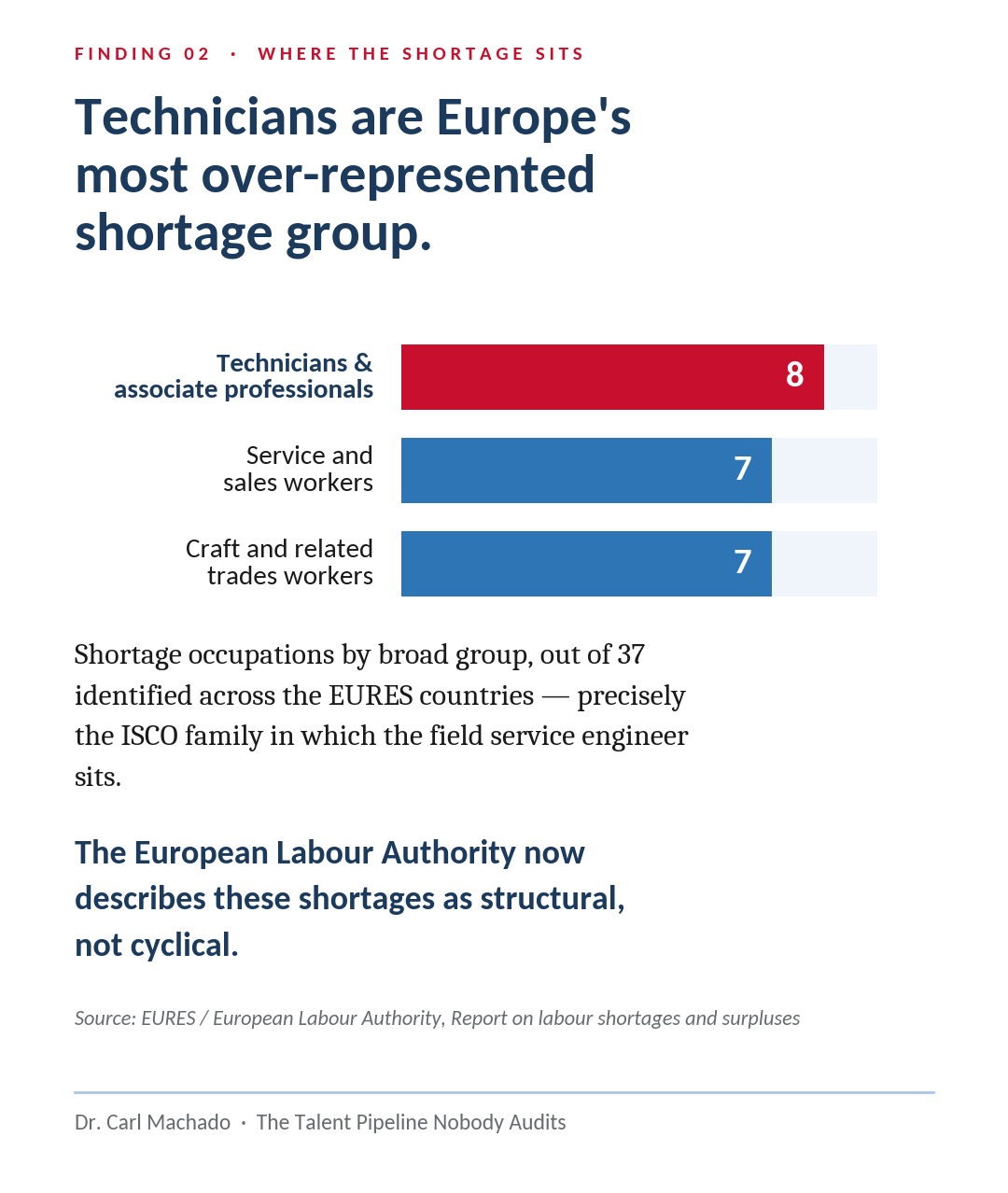
This matters because the shortage is not evenly spread. In the EURES report on labour shortages and surpluses, technicians and associate professionals form the largest single broad occupational group among identified shortage occupations — ahead of service and sales workers and of craft occupations. Many field-service roles sit within, or closely alongside, the technicians and associate professionals category, although the exact ISCO classification depends on the role’s technical level, qualification and actual duties.
The European Commission has identified 42 shortage occupations across Member States, and the European Labour Authority now characterises these shortages as increasingly structural rather than cyclical: driven by demographic change, skills mismatch, working conditions and limited mobility, and therefore not self-correcting when growth slows. Employers confirm the pressure — in the cited EIB-based analysis, 68 per cent of medium-sized companies identified skills shortages as a serious issue. Separately, the European Commission reported that 63 per cent of SMEs had difficulty finding the talent they needed.
A sector built on SMEs — where one person is a larger share of capability
According to MedTech Europe’s 2025 figures for its defined European market, the medical technology industry employs more than 930,000 people across approximately 38,000 companies, around 90 per cent of which are SMEs.
The structural implication is uncomfortable. In a company of forty people, a single senior field engineer may represent the entirety of a product line’s service capability in a region. Key-person risk that a large corporate can absorb is, for most of the European industry, existential.
And the demand signal is already specific. In BVMed’s autumn 2025 survey, ‘Medizintechniker’ was the most frequently named sought-after profile, cited by 38 per cent of respondents, narrowly ahead of engineers at 37 per cent. This is a survey signal, not a definitive ranking of hiring difficulty across the entire industry.
Germany as the leading indicator
German replacement demand for vocationally qualified STEM workers runs at 266,300 per year to 2026 and peaks at 271,700 per year over 2027–2031 — inside the planning horizon of any sitting board.
The Bundesagentur für Arbeit counted: The number fell from 183 in 2023 to 163 in 2024 and 157 in 2025 under the BA’s methodology. That easing should not be read as the disappearance of structural risk; it may reflect cyclical labour-market conditions as well as changes in the measured shortage landscape.
the number falls in a weak economy and rises again with recovery, while Germany’s longer-term demographic pressures remain.
The Dual Threat: Predictable Departures, Unplanned Absences
The talent pipeline crisis has two sources. Only one of them is on anyone’s plan.
The predictable one
Cohorts of field service engineers hired in the 1990s and early 2000s are approaching retirement. This is not a surprise; it is arithmetic, and Cedefop’s replacement-demand finding tells us it is the dominant driver of hiring need across Europe. Yet most companies still treat it as a management problem to be solved on the day the departure notice arrives.
There is a further trap in the tenure data. The cited study finds broadly stable job tenure in the countries and period it examines, with average tenure around eleven years and approximately half of workers remaining with the same employer for ten years or more. Stability of this kind is usually read as good news. In a service organisation it also means that the deepest, least documented, most customer-specific knowledge accumulates in the same individuals for a very long time — and leaves in a single event. Long tenure can create a concentration risk when customer-specific knowledge is not systematically transferred and documented.
The less predictable one
Long-term illness, family transitions, caregiving responsibilities and mobility constraints are not rare edge cases. A field engineer who cannot travel for several months during medical recovery may become unavailable for deployment, while an engineer on restricted duties may no longer be eligible for international assignments or high-risk procedures.
The pandemic demonstrated how quickly assumptions about workforce availability can break. I experienced this personally: under a hospital’s applicable access requirements, a colleague with an immunological condition could no longer be deployed to an operating theatre. The individual had not left the organisation, lost competence or become less committed. Yet, for the purposes of operating-room coverage, their deployable capacity disappeared almost overnight.
The work still had to be done. Someone else had to take over the case, learn the account context, support the procedure, protect the customer relationship and keep service running. This is Service Tetris in its most unforgiving form: the block remains visible on the organisational chart, but no longer fits the operating-room schedule.
The board-level question is not how to prevent illness, caregiving responsibilities or other unavoidable absences. It is whether knowledge documentation, cross-training and capacity planning are robust enough to absorb them without degrading service delivery.
For most companies, the honest answer is no.
The compound effect
These two threats combine into a third: cascading customer loss. When one engineer departs, the organisation mobilises and the disruption is contained. When three senior engineers in the same region or product line depart within eighteen months — the normal shape of a cohort-driven exit — the organisation does not mobilise with equivalent force, because it assumes it has handled gaps before. The cumulative effect is qualitatively different. Knowledge is not disrupted; it is lost.
The Audit Gap: Knowledge in Heads, Not Systems
Most service organisations would fail a structured audit of where critical knowledge actually lives. Four uncomfortable truths would surface.
Critical customer workflows exist only as tacit knowledge
Which theatre has a non-standard integration? Which hospital’s IT director requires formal coordination before any network restart? Which key account’s chief of clinical staff must be briefed before a device upgrade? The answers exist — as experience, not as procedure.
The CRM Gap: Critical Context Still Sits in People’s Heads
An account manager’s customer history — past problems, solutions, negotiation stances, political relationships — should be in the CRM. Often they are only in someone´s mind. When that manager is unavailable for three weeks, the colleague covering must reconstruct context, or miss signals and repeat solved problems.
Succession planning stops at the C-suite
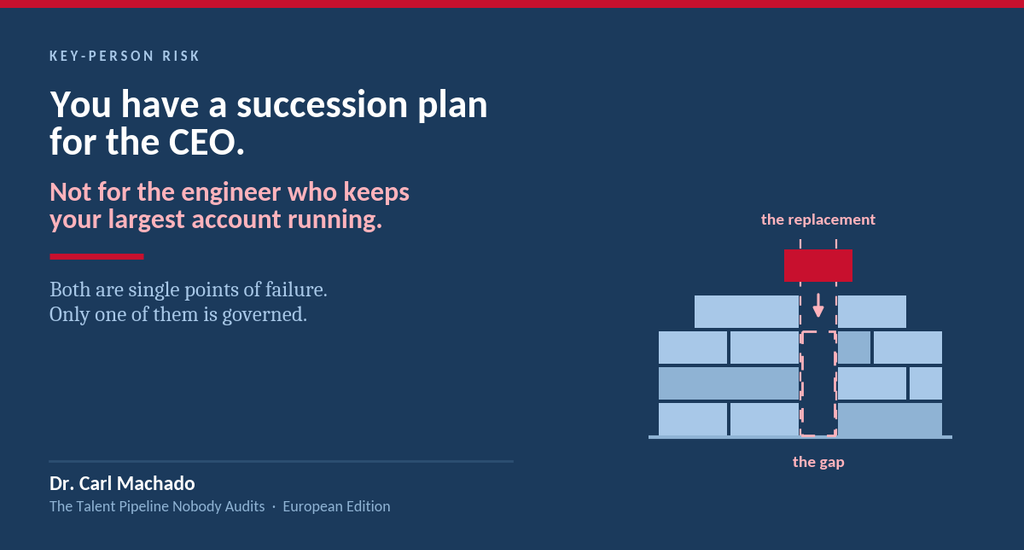
You almost certainly have a documented plan for CEO and Executive succession. You almost certainly do not have one for the retirement of your most experienced field service engineer in Asia-Pacific, or for the departure of your only clinical educator trained on the latest software platform.
The Regulatory Paradox
You already document competence. You are audited on it. It simply stops at the factory gate.
Under ISO 13485:2016, Clause 6.2, personnel performing work affecting product quality must be competent on the basis of education, training, skills and experience. The organisation must define the competence requirements, provide any necessary training, evaluate its effectiveness using methods appropriate to the training and the work performed, and maintain appropriate records. These are documented quality-system requirements that may be assessed during certification audits and regulatory inspections.
The EU Medical Device Regulation adds a specific governance requirement. Article 15 requires every manufacturer to have available at least one Person Responsible for Regulatory Compliance (PRRC) with the requisite expertise. Micro and small enterprises may make this function available externally, but the obligation itself remains.
Article 15 therefore recognises the critical importance of defined regulatory expertise and its reliable availability. It does not, however, prescribe a single-person dependency or directly regulate every technical competence required at a customer site.
Set the two side by side and the operational gap becomes obvious. We define, document and audit competence within the manufacturer’s quality system. Yet the competence that determines whether the device works in the customer’s actual theatre, on the customer’s actual network and under the customer’s actual escalation protocol may remain undocumented and concentrated in one person’s head.
That is not necessarily an automatic violation of ISO 13485 or MDR Article 15. It is, however, a potential weakness in service continuity, knowledge management, competence assurance and operational risk control.
The question is not whether the individual is competent. The question is whether the organisation can demonstrate, preserve and provide that competence when the individual is unavailable.
If the answer is no, the organisation has not necessarily failed a specific regulatory requirement. But it has created a preventable dependency at the point where the device meets the patient.
That is the regulatory paradox: competence is rigorously controlled inside the factory, while the competence that sustains safe and effective use in the field may remain informal, undocumented and person-dependent.
Why One Loss Becomes Many
A single departure is a problem, not a crisis. The multiplication happens through three channels, and boards should ask for each to be measured rather than asserted.
- Channel 1 — Continuity of relationship. Service quality is judged episodically, at the moment of failure. Degradation is invisible until a customer is already in a procurement conversation.
- Channel 2 — Replacement cost and lead time. Recruitment competes in the tightest occupational segment in Europe; onboarding to full customer-facing competence then runs for minimum 6 months, during which productivity is partial and supervision consumes senior capacity.
- Channel 3 — Escalation and compliance load. Problem-solving time rises, first-time-fix falls, escalations increase, and with them the probability of complaint handling, vigilance workload and regulatory attention.
A note on numbers. There is no credible European dataset that quantifies the churn effect of a service departure, and any such figure quoted with confidence should be treated with suspicion. What can be done — and what boards should require — is an internally calibrated model using the company’s own data: revenue at risk per key account, historical NPS movement around service transitions, actual time-to-competency by market, and actual escalation rates before and after personnel change. The value lies in the calibration, not in a borrowed benchmark.
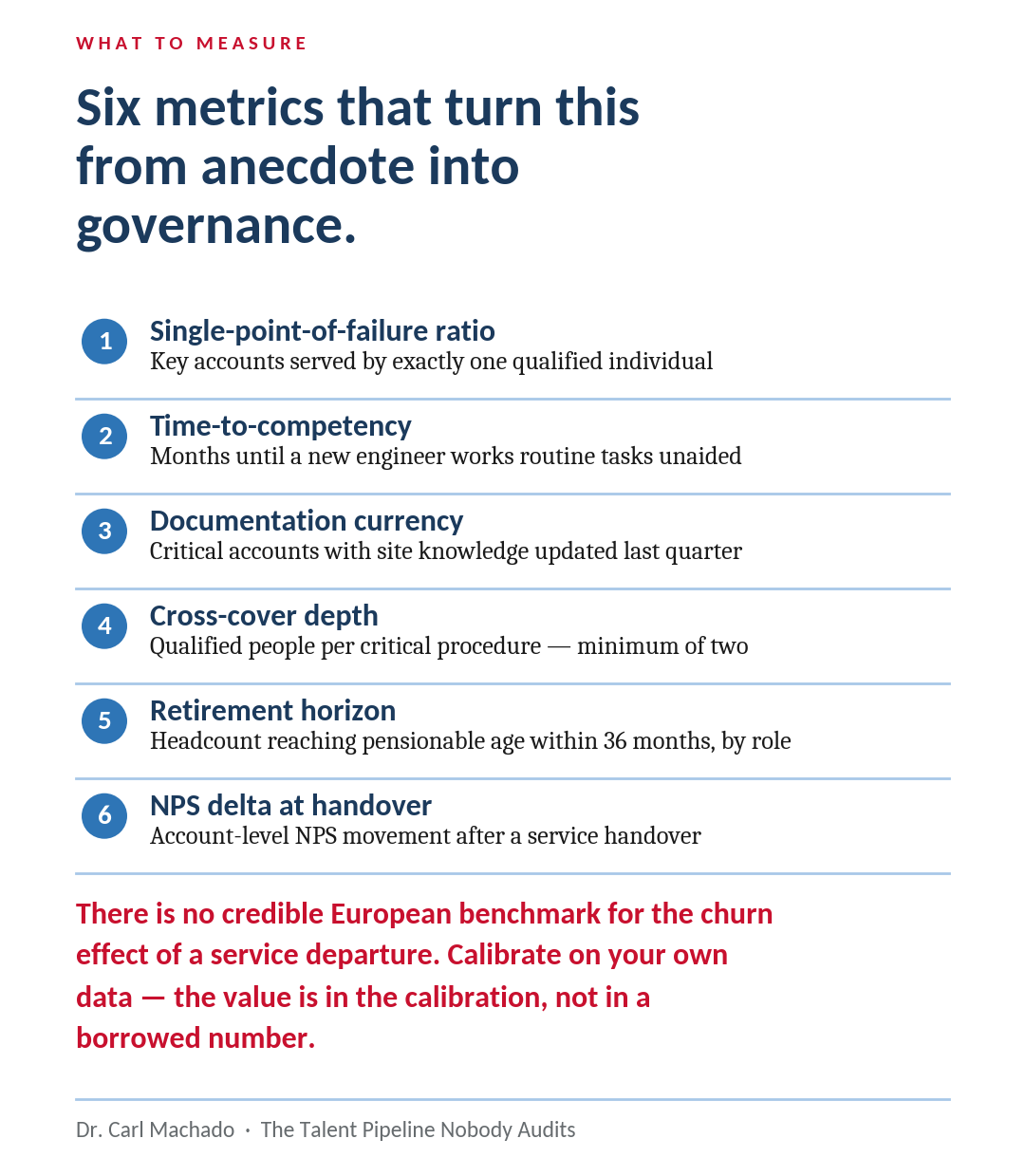
Documented Knowledge as an Operational Requirement
The solution is not recruitment, though recruitment is part of it. It is not compensation, though fair compensation matters — and in a market where technicians are the scarcest broad occupational group in Europe, pay positioning is a retention control, not a cost line. The solution is systematic, enforced documentation of critical knowledge.
This is not a nice-to-have. It is an operational requirement, governed like quality control or regulatory compliance.
Layer one: documentation that lives and creates value
For field service engineers:
- Access codes, credentials and contact chains for every major customer site
- Standard operating & decision procedures for each customer’s integration landscape
- Escalation and coordination protocols — who to call, when, and in what sequence
- Known issues and their workarounds, by customer and installed base
- Spare parts and tooling requirements, by e.g. surgeon & procedure type
For clinical specialists & educators and key account managers:
- Customer clinical and organisational challenges, with proposed solutions
- Negotiation history and commercial terms, with decision-making context
- Training needs assessments and competency gaps for each site
- Relationships and political dynamics within the customer organisation
- Regulatory and compliance requirements specific to that customer or market
This documentation is not archived. It is updated bi-annually, it is part of role evaluation, and it is auditable. When someone leaves or goes on extended leave, a peer substitutes because the knowledge is accessible, current and structured.
Layer two: cross-training as a control, not an event
Not an annual exercise, but a standing requirement that at least two people can execute every critical procedure or support request for every major customer. Where the cross-cover depth falls to one, that is a finding — with an owner and a date.
Layer three: time-to-competency as a managed metric
New field engineers should reach basic competency — able to handle the large majority of routine tasks unaided — in months rather than the better part of a year. That requires structured training, documented procedures and a genuine mentoring commitment. Most organisations do not measure this at all. Those that do typically discover wide variation between mentors and between markets, which is itself the finding: the variation is a training-system defect, not a people problem.
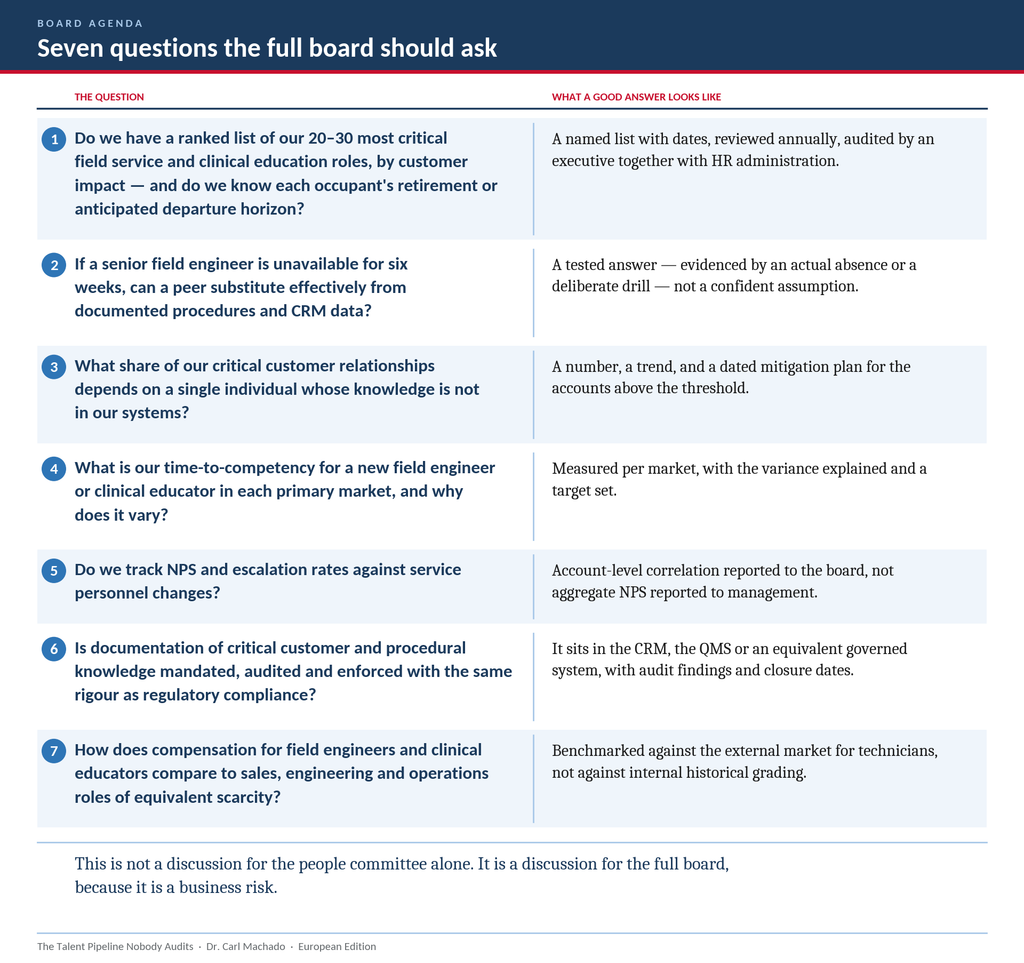
Seven Questions for the Board
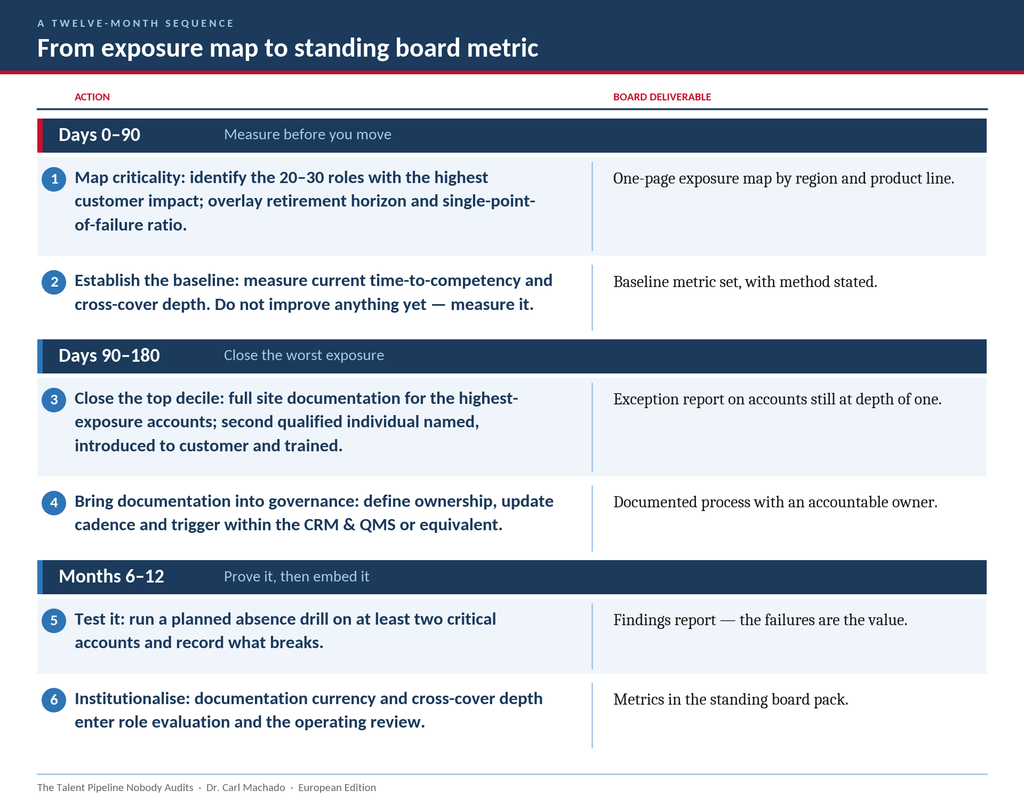
A Twelve-Month Sequence
Boards do not need another risk described to them. They need a sequence they can hold management to.
The Invisible Dependency
Service executives have a standing complaint: the board cares about revenue and cost, and does not understand service strategy. This misses the point. Boards do not ignore service. They ignore service visibility.
When service runs well it is invisible. Devices work, customers are satisfied, there are no crises and no regulatory findings. From the board’s perspective the service organisation is simply operating as expected — a cost centre, not a strategic asset.
When service fails it becomes highly visible. Customers defect, NPS collapses, findings emerge, and the executive team spends weeks or months in damage control. The board asks how this happened and why it was not told.
The service talent pipeline occupies exactly this space, between invisibility and catastrophe. Right now, in most organisations, it is invisible. The knowledge exists, the relationships hold, customers are retained. There is no crisis.
But the European data describes what happens next with unusual clarity. Nine in ten openings will come from replacement, the scarcest occupational group in Europe is precisely the one service depends on, and the most-wanted role in German MedTech is already the Medizintechniker. The demographic wave is not an abstract scenario. Its timing is sufficiently foreseeable to require action within the current planning horizon.
This is preventable. It is not prevented by hiring better people. It is prevented by auditing where critical knowledge lives, documenting that knowledge as a business requirement, and building a pipeline of trained successors before the departure happens.
The Tetris blocks are falling. The question is whether you notice before the board flattens.
About the Author
Dr. Carl Machado is an MedTech executive with global responsibility in a leading MedTech company. His background spans emergency medicine, organisational leadership, and governance in healthcare technology. He writes on leadership, strategic execution, and organisational effectiveness.
Sources
A · European institutions and statistics
- Cedefop, Skills Forecast — replacement demand. 2025 country reports; 2026 release of the online tool, which adds a dedicated replacement-demand analysis.
https://www.cedefop.europa.eu/en/tools/skills-forecast
https://www.cedefop.europa.eu/files/skills_forecast_-_germany_2025.pdf
https://www.cedefop.europa.eu/en/news/cedefop-updates-skills-forecast-new-data-guide-europes-skills-and-labour-market-policy-2035 - Cedefop, „Baby boomers retiring in the wake of the pandemic“ — source of the finding that roughly nine in ten future job openings are driven by replacement needs.
https://www.cedefop.europa.eu/en/news/baby-boomers-retiring-wake-pandemic
https://www.cedefop.europa.eu/en/tools/skills-intelligence/trend-focus/future-jobs - Eurostat, Population structure and ageing — data as at 1 January 2025 (share aged 65+, dependency ratios).
https://ec.europa.eu/eurostat/statistics-explained/index.php?title=Population_structure_and_ageing - Eurostat, Population projections in the EU — old-age dependency ratio trajectory to 2100.
https://ec.europa.eu/eurostat/statistics-explained/index.php?title=Population_projections_in_the_EU - European Commission, DG EMPL, Labour Market and Wage Developments in Europe, Annual Review 2024, Chapter 3 — labour force participation and employment of older people, based on the Eurostat Labour Force Survey. Source of the 39 million / 19.9 % figures.
https://op.europa.eu/webpub/empl/lmwd-annual-review-report-2024/chapter3/the-labour-force-participation-and-employment.html - European Labour Authority / EURES, Report on labour shortages and surpluses — editions 2023, 2024 and 2025. The occupational-group breakdown (technicians and associate professionals as the largest group among 37 identified shortage occupations) is from the 2023 edition.
https://eures.europa.eu/living-and-working/labour-shortages-and-surpluses-europe_en
https://www.ela.europa.eu/sites/default/files/2025-06/EURES_Report_on_labour_shortages_and_surpluses_2024.pdf
https://www.ela.europa.eu/sites/default/files/2026-06/labour-shortages-report-ela-2025.pdf
https://www.ela.europa.eu/sites/default/files/2024-07/Eures-hortages_Extra-4_IT.pdf - European Commission, „Tackling labour and skills shortages in the EU“, press release, 20 March 2024 — 42 shortage occupations identified; 63 % of SMEs report they cannot find the talent they need.
https://commission.europa.eu/news-and-media/news/tackling-labour-and-skills-shortages-eu-2024-03-20_en - European Commission, COM(2025) 959 final, 25 November 2025 — EU job vacancy rate (2.2 %, Q1 2025); 68 % of medium-sized companies reporting skills shortages as a serious issue, citing the EIB Investment Survey 2024.
https://employment-social-affairs.ec.europa.eu/document/download/cb0ffdb5-1f80-4e20-a535-b2237b31f29f_en?filename=COM_2025_959_1_EN.pdf
B · Industry and national sources
- MedTech Europe, Facts & Figures 2025, published 4 September 2025 — employment, company count, SME share and value added per employee.
https://www.medtecheurope.org/wp-content/uploads/2025/09/medtech-europe-facts-and-figures-2025-digital-1.pdf
https://www.medtecheurope.org/2025/09/04/medtech-europe-unveils-facts-figures-2025-a-snapshot-of-innovation-and-impact-in-europe/
https://www.medtecheurope.org/datahub/employment-companies/ - BVMed, Zahlen und Fakten, and Herbstumfrage 2025 (116 responding companies) — German MedTech employment and most sought-after roles. The employment figure of 212,100 for 2024 originates with WifOR, Gesundheitswirtschaftliche Gesamtrechnung, as reported by BVMed.
https://www.bvmed.de/branche/zahlen-und-fakten
https://www.bvmed.de/branche/lage/ergebnisse-der-bvmed-herbstumfrage-2025
https://www.bvmed.de/themen/standort-de/sonderstudie-des-bmwe-zur-medtech-branche-2025 - Anger, C., Betz, J. and Plünnecke, A. (2025), MINT-Frühjahrsreport 2025: Arbeitsmarktbericht — Gute Gründe für MINT. Institut der deutschen Wirtschaft Köln, 21 May 2025. The replacement-demand figures used here are Table 1-3, p. 18.
https://www.iwkoeln.de/fileadmin/user_upload/Studien/Gutachten/PDF/2025/MINT-Fr%C3%BChjahrsreport-2025-Arbeitsmarktbericht.pdf
https://www.iwkoeln.de/studien/christina-anger-julia-betz-axel-pluennecke-arbeitsmarktbericht-gute-gruende-fuer-mint.html - Bundesagentur für Arbeit, Fachkräfteengpassanalyse 2025 (Blickpunkt Arbeitsmarkt) — 157 shortage occupations in 2025, against 163 in 2024 and 183 in 2023.
https://statistik.arbeitsagentur.de/DE/Navigation/Statistiken/Interaktive-Statistiken/Fachkraeftebedarf/Engpassanalyse-Nav.html
https://www.frauundberuf-bw.de/fileadmin/FuB-contentbilder/themen/2025_BA-FK-Engpassanalyse.pdf - Goulart, K. and Oesch, D. (2024), „Job tenure in Western Europe, 1993–2021: Decline or stability?“, European Journal of Industrial Relations — based on the European Labour Force Survey and the European Working Conditions Survey.
https://journals.sagepub.com/doi/10.1177/09596801241268144
C · Standards and regulation
- ISO 13485:2016, Medical devices — Quality management systems — Requirements for regulatory purposes, Clause 6.2 (Human resources): competence, documented training process, effectiveness check proportionate to risk, and records.
https://www.iso.org/standard/59752.html
https://www.iso.org/obp/ui/#iso:std:iso:13485:ed-3:v1:en - Regulation (EU) 2017/745 on medical devices (MDR), Article 15 — person responsible for regulatory compliance. OJ L 117, 5.5.2017, p. 1; consolidated text of 10 January 2025.
https://eur-lex.europa.eu/eli/reg/2017/745/2025-01-10/eng - MDCG 2019-7 Rev. 1, Guidance on Article 15 of the MDR and IVDR regarding a ‚person responsible for regulatory compliance‘ (PRRC).
https://health.ec.europa.eu/system/files/2023-12/md_mdcg_2019_7_guidance_art15_mdr_ivdr_en.pdf
Links verified 18 August 2026.